Generative AI Strategy for Enterprises: From AI Experiments to Measurable Business Results
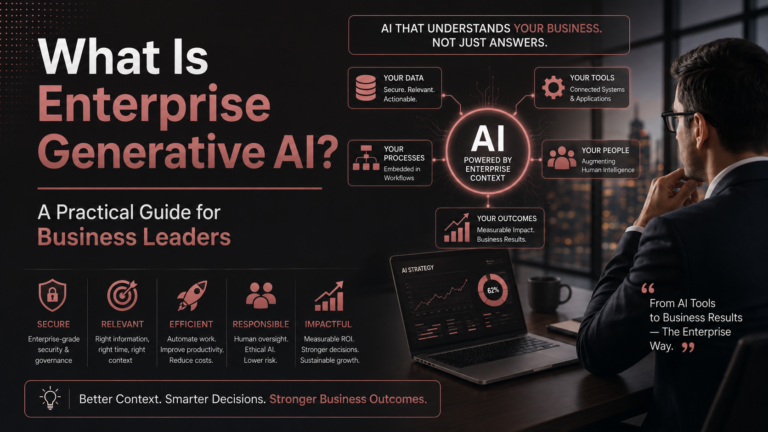
A Generative AI strategy for enterprises is a structured approach to identifying the right AI use cases, assessing organisational readiness, measuring business value, and moving successful AI experiments into production. It goes beyond giving employees access to ChatGPT, Copilot or Gemini. A strong enterprise AI strategy connects business priorities with the right technology, data, governance, adoption model and measurable outcomes.
For many organisations, the challenge is no longer “Should we use Generative AI?” It is “Where should we use it, what should we build, and how will we prove that it is creating business value?”
The difference between an AI experiment and an enterprise AI capability lies in what happens after the demo: clear use-case prioritisation, AI readiness, appropriate architecture, measurable ROI, responsible governance and sustained adoption.
In this guide, we will look at how business leaders can build a Generative AI roadmap that moves from experimentation to practical, measurable enterprise results.
What is an enterprise Generative AI strategy?
A Generative AI strategy for an enterprise is a business-led framework for identifying, prioritising, implementing and scaling AI use cases while managing ROI, data, security, governance and adoption.
A practical strategy should answer seven questions:
| Question | What the enterprise needs to know |
|---|---|
| Why? | What business objective are we trying to improve? |
| Where? | Which workflows have genuine AI potential? |
| Who? | Who owns the business outcome? |
| What? | Which AI approach is appropriate? |
| Can we? | Are our data, systems and people ready? |
| How much? | What will it cost and what value could it create? |
| What next? | How will the pilot move into production or be stopped? |
This is why enterprise AI strategy is different from enterprise AI adoption.
AI adoption is about using the technology.
AI strategy is about deciding where the technology deserves to be used.cision.
What is the difference between an AI experiment and an enterprise AI strategy?
An AI experiment asks:
“Can this technology do something interesting?”
An enterprise strategy asks:
“Should the organisation invest in this capability, where, why and at what scale?”
| AI experiment | Enterprise AI strategy |
| Starts with a tool | Starts with a business problem |
| Demonstrates capability | Measures business value |
| Often has a short-term owner | Has accountable ownership |
| May use sample data | Addresses production data |
| Focuses on the demo | Focuses on workflow impact |
| Success = “it works” | Success = KPI improvement |
| Often isolated | Connected to business priorities |
| May stop after POC | Has a production decision |
This distinction is one of the most important shifts leaders need to make.
A successful demo is not necessarily a successful AI project.
Why are enterprises struggling to move from AI pilots to business results?
There are five recurring problems.
1. The technology comes before the problem
Teams discover a new model and immediately ask where they can use it.
A better starting point is:
Which process is expensive, repetitive, slow, data-heavy or difficult to scale?
The technology should follow the problem.
2. There is no baseline
If an organisation claims that AI saves 30% of processing time, the obvious question is:
30% compared with what?
Without a baseline, ROI becomes an assumption rather than a measurement.
3. Nobody owns the production outcome
A technology team may own the POC.
The business team owns the workflow.
Security owns controls.
Finance owns the economics.
If nobody owns the combined outcome, the pilot can stall between departments.
4. Governance enters too late
Security, legal and compliance should not be invited only after the architecture has been selected.
They should influence use-case selection.
The LEADxAI framework explicitly places legal, compliance and security considerations early in the FOCUS stage rather than waiting until deployment.
5. Access is confused with adoption
Buying an AI subscription does not mean employees have changed how they work.
Adoption requires:
- a useful workflow
- clear ownership
- employee confidence
- appropriate training
- measurement
- leadership support
Google’s current guidance similarly favours content that provides genuinely useful information rather than content produced primarily to manipulate search visibility. The same discipline is useful here: AI activity is not the same thing as AI value.e.
What should an enterprise Generative AI strategy contain?
A practical strategy should cover the full path from diagnosis to scale.
| Strategy layer | Core question | Example output |
| Business context | What matters to the organisation? | Strategic priorities |
| AI readiness | Are we ready? | Readiness scorecard |
| Opportunity discovery | Where can AI help? | Use-case inventory |
| Prioritisation | What should we do first? | Ranked roadmap |
| Architecture | How should it work? | Solution blueprint |
| Economics | Does it make financial sense? | Business case |
| Governance | What controls are required? | AI governance rules |
| Adoption | Will people actually use it? | Adoption plan |
| Measurement | Did it create value? | KPI dashboard |
| Scale | What should happen next? | AI operating rhythm |
This is the difference between an AI shopping list and an enterprise AI strategy.
The 5-step framework for building an enterprise GenAI strategy
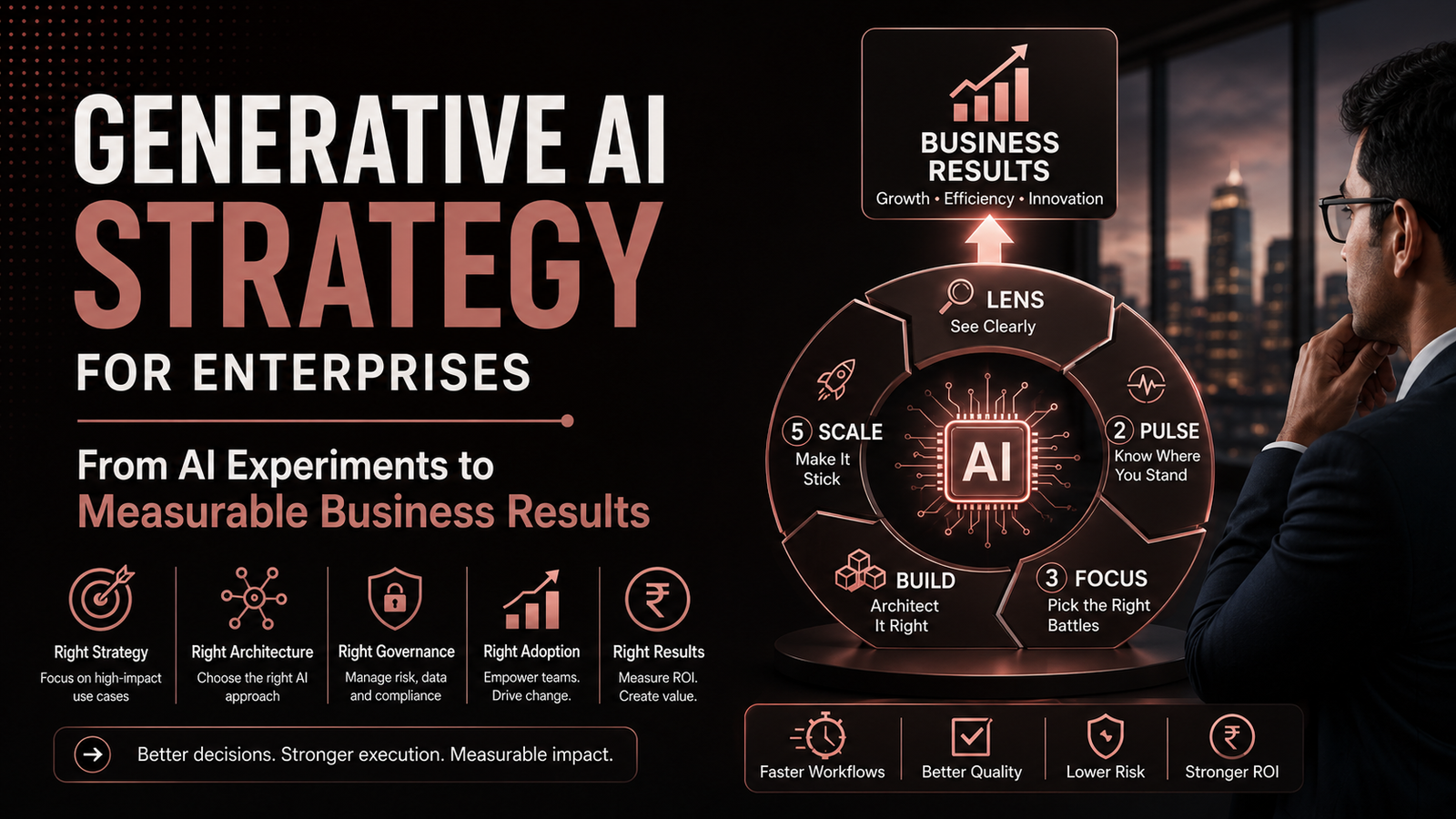
A practical enterprise strategy can be organised into five stages:
LENS → PULSE → FOCUS → BUILD → SCALE
These five frameworks are part of the LEADxAI Enterprise GenAI Leadership System and provide a progression from understanding the landscape to readiness, prioritisation, architecture and scale.
1. LENS: See clearly
The first step is to understand what Generative AI can and cannot realistically do.
Enterprise leaders should distinguish between:
- AI tools
- AI-assisted processes
- AI-powered products
- RAG systems
- AI agents
- model customisation
- conventional automation
The question is not:
“What is the most advanced AI technology?”
The question is:
“What capability does this business problem actually require?”
That distinction prevents technology from becoming the strategy.
What should leaders understand before choosing an AI solution?
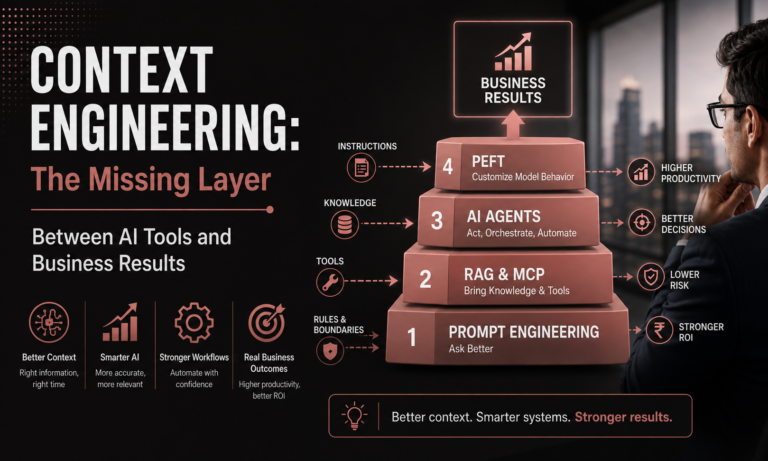
At minimum, leaders should understand four levels of Context Engineering:
| Level | Capability | Business question |
| 1 | Prompt Engineering | Can better instructions solve the problem? |
| 2 | RAG + MCP | Does AI need enterprise knowledge or tool access? |
| 3 | AI Agents | Does AI need to perform multi-step work? |
| 4 | PEFT | Does the model itself need deeper customisation? |
The Context Engineering model in LEADxAI uses these four levels to give leaders a mental model for evaluating AI capabilities without requiring them to become developers.
2. PULSE: Know where you stand
Before selecting large AI investments, assess enterprise readiness.
A useful AI readiness assessment should examine:
| Readiness area | Key question |
| People | Do employees have the required AI capability? |
| Processes | Are target workflows documented and measurable? |
| Data | Is the required information usable and accessible? |
| Technology | Can existing systems support the solution? |
| Security | Are data and access controls adequate? |
| Skills | Do we have builders, users and owners? |
| Governance | Are policies and accountability clear? |
The PULSE framework also considers tool sprawl, data readiness tiers, process mapping, skills gaps, security and GenAI maturity.
What is an enterprise AI readiness assessment?
An enterprise AI readiness assessment evaluates whether an organisation has the data, processes, technology, people, skills, security and governance required to deploy AI successfully.
It should not simply ask:
“Do we have AI tools?”
It should ask:
“Can this organisation reliably put AI into a real business workflow?”
That is a much more useful question.
3. FOCUS: Pick the right AI use cases
Once readiness is understood, the organisation can identify potential use cases.
The FOCUS framework is designed around:
- use-case discovery
- impact × feasibility
- adoption-first thinking
- quick wins
- strategic bets
- early compliance
- kill criteria
- ROI estimation.
How should an enterprise prioritise Generative AI use cases?
Start with the processes that have:
- high frequency
- significant manual effort
- measurable output
- repetitive work
- accessible data
- clear business ownership
- realistic AI feasibility
Then score them.
Enterprise AI use-case prioritisation matrix
| Factor | Low score | High score |
| Business impact | Minor improvement | Material KPI impact |
| Feasibility | Difficult to implement | Technically straightforward |
| Data readiness | Poor | Ready |
| Adoption | Major behaviour change | Fits existing workflow |
| Risk | Difficult to govern | Manageable |
| Economics | Unclear | Measurable |
A high-value AI strategy does not necessarily begin with the most impressive use case.
It often begins with the use case where the organisation can learn, measure and scale.
What are good enterprise Generative AI use cases?
Good candidates often involve workflows that are repetitive, information-heavy or require significant analysis.
Examples include:
| Function | Potential AI application |
| Sales | Proposal analysis, account research, lead qualification |
| Marketing | Content workflows, customer research, campaign analysis |
| HR | Recruitment assistance, job descriptions, employee knowledge |
| Finance | Document analysis, reporting assistance, invoice workflows |
| Operations | Knowledge retrieval, process assistance, forecasting support |
| Customer Support | Knowledge-based responses, triage, escalation |
| Supply Chain | Information analysis, demand-related workflows |
| Management | Decision support, RCA, SWOT, risk analysis |
The ADS curriculum specifically uses function-level AI audits across Marketing, Sales, HR, Finance, Supply Chain and Operations and asks leaders to identify repetitive tasks, assess AI feasibility and prioritise impact.
4. BUILD: Choose the right architecture
This is where an enterprise needs enough technical understanding to make good decisions.
The wrong approach is:
“We should build an AI agent because agents are the future.”
The better approach is:
“What does this workflow require?”
Should an enterprise use prompting, RAG, MCP, AI agents or fine-tuning?
Use the simplest architecture that can reliably solve the business problem.
| Business requirement | Possible approach |
| Better instructions | Prompt Engineering |
| Internal company knowledge | RAG |
| Connection to enterprise tools | MCP / tool integration |
| Multi-step autonomous workflow | AI Agent |
| Deeper model behaviour customisation | PEFT / fine-tuning |
| Simple deterministic workflow | Automation / conventional software |
That final option is important.
Not every problem needs Generative AI.
A rules engine, workflow automation or conventional software solution may sometimes be cheaper, more reliable and easier to govern.
Good enterprise AI strategy includes the ability to say:
“AI is not the right answer for this problem.”
RAG vs AI Agents vs Fine-Tuning: What should an enterprise choose?
This question comes up frequently because these technologies solve different problems.
Use RAG when:
The model needs access to changing or proprietary enterprise knowledge.
For example:
“Answer this employee’s question using our current HR policies.”
Use MCP or tool integration when:
The AI needs to interact with external tools, systems or data sources.
Use an AI agent when:
The system needs to perform multiple steps rather than simply generate an answer.
For example:
Research → analyse → prepare report → update system.
Consider PEFT or fine-tuning when:
The model’s behaviour genuinely needs deeper customisation that cannot reasonably be achieved through prompting and context.
The LEADxAI curriculum explicitly teaches leaders to decide between Prompt Engineering → RAG → MCP → Fine-tuning based on the actual requirement.
5. SCALE: Turn AI pilots into operating capability
The final stage is scale.
This requires more than deployment.
An enterprise needs:
- AI governance
- ownership
- adoption measurement
- evaluation
- AI champions
- usage policies
- KPI tracking
- review cadence
- stop/pivot/scale criteria
The SCALE framework specifically addresses the “frozen middle”, change management, AI champions, AI Rhythm, functional KPIs, usage policy and kill criteria.
Why does the “frozen middle” matter in enterprise AI adoption?
Senior leadership may support Generative AI.
Technology teams may support it.
But the people managing day-to-day workflows determine whether the new way of working actually becomes normal.
That is the frozen middle problem:
Leadership says yes. Technology says yes. The workflow does not change.
Enterprise AI adoption therefore needs both:
top-down sponsorship + middle-out adoption.
How do you measure Generative AI ROI?
Generative AI ROI should be measured against a baseline rather than estimated from enthusiasm.
At minimum, establish:
- Current process volume
- Current processing time
- Current cost
- Current quality/error rate
- Expected AI-assisted performance
- Adoption rate
- Technology cost
- Implementation cost
- Governance/security cost
- Business impact
The AI ROI Engine in the ADS curriculum uses four steps:
Metrics → Prioritise → Automate → Deploy & Track.
What metrics should enterprises use to measure GenAI ROI?
Different functions need different KPIs.
| Function | Possible KPI |
| Customer support | Resolution time, first-contact resolution, escalation |
| Finance | Processing time, error rate, cost per transaction |
| Sales | Research time, proposal turnaround, conversion |
| HR | Screening time, response time, workflow completion |
| Operations | Cycle time, throughput, quality |
| Knowledge work | Time saved, output quality, adoption |
Time saved is useful.
But it should not be the only metric.
A stronger business case combines:
efficiency + quality + adoption + financial impact + risk.
RAG, agents or fine-tuning: what should an enterprise choose?
One of the most common strategy mistakes is jumping directly to the most technically sophisticated option.
An organisation might assume it needs to fine-tune a model when better context would solve the problem.
Or it might build an autonomous agent for a process that only requires document retrieval.
The decision should start with the business requirement.
A simple decision tree
Does the model simply need better instructions?
→ Start with prompting.
Does it need reliable access to changing internal knowledge?
→ Consider RAG.
Does it need to interact with enterprise tools or systems?
→ Consider tool integration or MCP.
Does it need to execute a multi-step workflow?
→ Consider an agent.
Does the model itself need behaviour that cannot reasonably be achieved through context and prompting?
→ Evaluate fine-tuning or PEFT.
The important word is evaluate.
Fine-tuning should be a decision, not a badge of technical sophistication.
5. SCALE — Make it stick
A successful pilot is not the finish line.
It is the beginning of the operating model.
At scale, the organisation needs:
- clear ownership
- AI usage policies
- evaluation standards
- security controls
- adoption measurement
- AI champions
- recurring reviews
- business KPIs
- criteria for stopping unsuccessful initiatives
This is where many organisations encounter the “frozen middle”.
Senior leadership may support AI.
The technology team may support AI.
But middle management controls many of the workflows, incentives and daily behaviours that determine whether adoption actually happens.
AI transformation therefore needs both top-down sponsorship and middle-out adoption.
How to calculate Generative AI ROI
“AI will save time” is not a business case.
A credible business case starts with a baseline.
For each proposed use case, capture:
- Current process volume
- Current time per transaction
- Current labour cost
- Current error or rework rate
- Expected AI-assisted time
- Expected quality change
- Technology cost
- Implementation cost
- Adoption rate
- Risk or control cost
For example:
| Metric | Before AI | After AI | Measurement |
| Processing time | 30 min | 18 min | Time per transaction |
| Monthly volume | 10,000 | 10,000 | Transactions |
| Rework rate | 8% | 5% | Quality |
| AI adoption | 0% | 70% | Active users |
| Cost per transaction | Baseline | Target | Unit economics |
The exact financial outcome will differ by organisation.
The important thing is that the measurement system exists before the project is declared a success.
That is the difference between an AI demo and an investment case.
Why the POC-to-production gap matters
An enterprise can prove that a model works in a controlled demonstration and still fail to deploy it.
The production environment introduces questions that a demo may not answer:
- What happens when the model is wrong?
- Who reviews high-risk outputs?
- What happens when the underlying data changes?
- How is access controlled?
- What is the cost per transaction?
- How is quality evaluated?
- What happens when an API fails?
- What is the escalation path?
- Who owns the result?
This is why architecture, governance and economics should be considered before a POC becomes politically difficult to stop.
A useful enterprise AI strategy therefore has kill criteria.
If a project fails to meet agreed thresholds for quality, adoption, economics, security or business impact, leadership should be able to stop it.
Stopping a bad AI project is a strategy success.
Governance should begin before deployment
Enterprise AI governance should not be a document written after the first production incident.
At minimum, leadership should establish rules around:
- sensitive data
- personally identifiable information
- access control
- model usage
- human review
- vendor risk
- evaluation
- auditability
- incident response
- accountability
The underlying principle is simple:
AI can assist with a decision. Accountability still belongs to a person or organisation.
This becomes even more important as organisations move from conversational AI towards systems that can take actions.
The 90-day enterprise GenAI roadmap
A useful first roadmap can be structured into four phases.
Days 1–20: Diagnose
- Audit existing AI tools
- Identify current pilots
- Assess data readiness
- Map major workflows
- Establish baseline KPIs
- Identify governance gaps
Days 21–45: Design
- Prioritise use cases
- Build business cases
- Select architecture
- Identify owners
- Define success criteria
- Involve security and compliance
Days 46–80: Deploy
- Run selected implementation
- Measure adoption
- Evaluate quality
- Monitor unit economics
- Resolve workflow problems
Days 81–90: Decide
For each initiative:
Scale → Improve → Pause → Stop
The objective is not to manufacture a success story.
It is to create enough evidence for the next investment decision.
For larger organisations, this can develop into a broader transformation programme with diagnosis, use-case design, deployment and governance stages. The LEADxAI delivery blueprint uses a similar progression through LENS, PULSE, FOCUS, BUILD and SCALE.
10 questions every leadership team should ask before approving an AI project
Before approving another Generative AI pilot, ask:
- What business problem are we solving?
- What KPI should move if this works?
- What is the current baseline?
- Why does this need Generative AI?
- Is our data ready?
- Who owns the business outcome?
- What architecture does the use case actually require?
- What will the solution cost at production scale?
- What are the security, compliance and governance requirements?
- Under what conditions will we stop the project?
If the team cannot answer these questions, the organisation may not have an AI project yet.
It may only have an interesting demonstration.
Enterprise Generative AI strategy: a practical checklist
Use this as a leadership review before the next AI investment.
- Business objective is clearly defined
- Baseline KPI is documented
- AI use case has a named owner
- Existing alternatives have been considered
- Data readiness has been assessed
- Security and compliance requirements are known
- Architecture has been selected for the actual problem
- Implementation cost is estimated
- Expected business value is measurable
- Adoption plan exists
- Evaluation criteria are defined
- Production owner is identified
- Kill criteria are agreed
- Leadership review cadence is established
The checklist is deliberately simple.
Enterprise AI strategy does not fail because organisations cannot create complicated frameworks.
It often fails because basic decisions remain ambiguous.
The real objective: fewer experiments, better decisions
The next phase of enterprise Generative AI will not be won by the company with the largest number of pilots.
It will be won by organisations that learn how to distinguish:
- experiment from evidence,
- automation from AI,
- demo from deployment,
- adoption from access,
- and activity from measurable business value.
That requires a different kind of AI leadership.
Leaders do not need to know how to build every RAG pipeline, train every model or write every agent.
They do need to know when those technologies make sense, what they should cost, what risks they introduce, what questions to ask the implementation team, and how to decide whether the resulting workflow deserves to scale.
That is the decision layer of enterprise Generative AI.
And that is where an effective strategy begins.