What Is Enterprise Generative AI? Definition, Use Cases, Architecture & Strategy
Enterprise Generative AI is no longer just about giving employees access to ChatGPT, Claude or Gemini.
The harder business question is:
How do you turn Generative AI into a reliable part of the way your organisation works?
That means connecting AI with the right business processes, organisational knowledge, systems and controls – and then measuring whether the resulting workflow actually improves a business outcome.
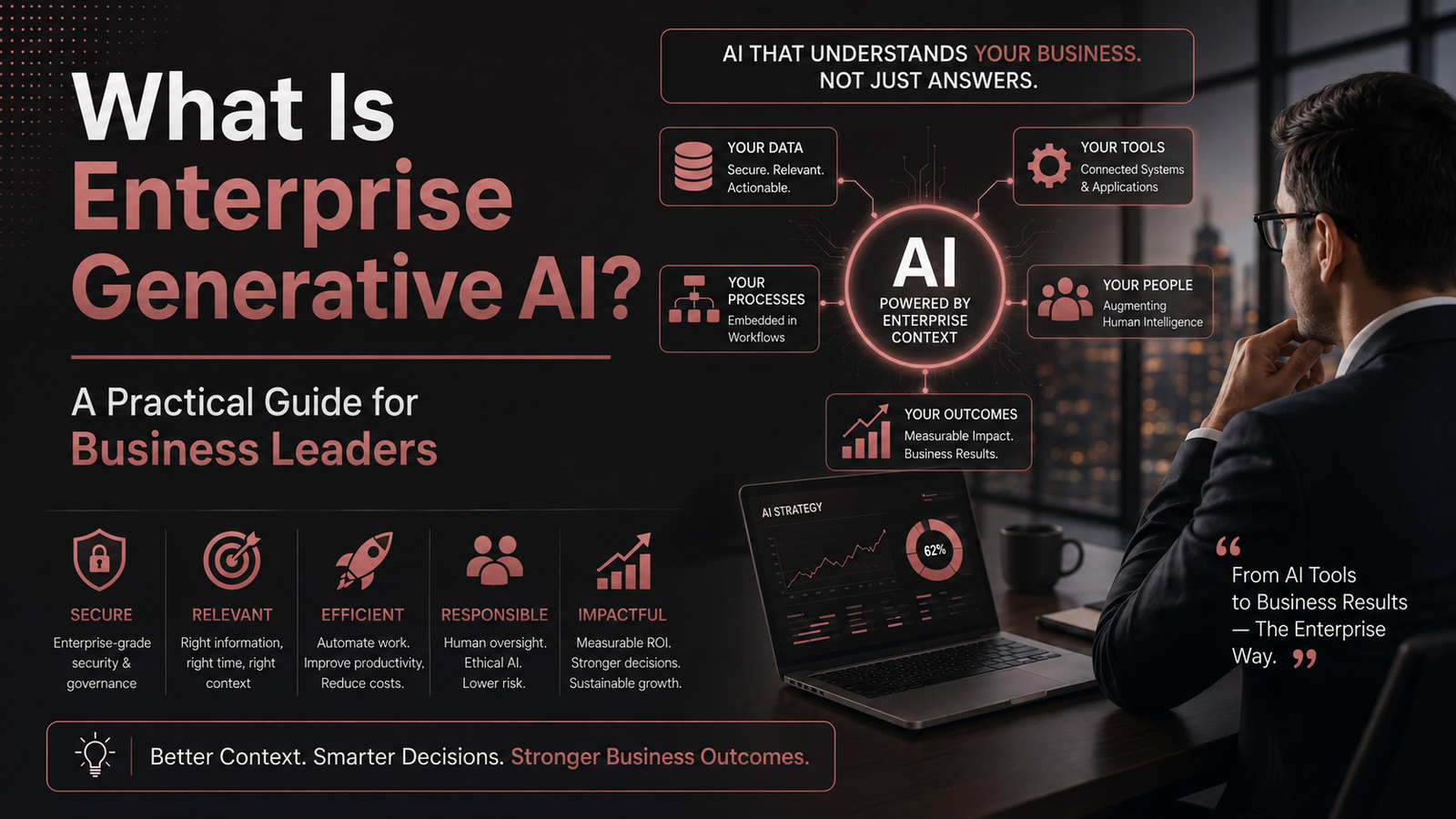
Enterprise Generative AI is the use of Generative AI within an organisation’s data, systems and workflows to support or automate valuable business work while operating within appropriate security, governance and human-accountability boundaries.
For a Business Leader, this creates a different set of questions:
- Where should we use AI?
- Which processes are actually suitable?
- What information should AI have access to?
- When is prompting enough?
- When do we need RAG?
- When does an AI agent make sense?
- What will it cost?
- How will we measure ROI?
- Who remains accountable when AI gets something wrong?
These are not purely technical questions.
They are business decisions.
Enterprise Generative AI at a glance
| Area | Enterprise Generative AI |
|---|---|
| Purpose | Improve or automate defined business workflows |
| Data | Organisational and approved external information |
| Models | LLMs and other Generative AI models |
| Context | Prompts, knowledge, retrieval, tools and business rules |
| Integration | CRM, ERP, HR, ITSM, data platforms and other systems |
| Security | Identity, permissions, data controls and monitoring |
| Governance | Policies, evaluation, escalation and accountability |
| Measurement | Business KPIs, cost, quality, adoption and risk |
| Human role | Human ownership remains for consequential outcomes |
The key distinction is simple:
- Consumer AI helps a person do a task.
- Enterprise AI makes AI part of a controlled business process.
Enterprise AI vs ChatGPT: what is the difference?
ChatGPT can absolutely be part of an enterprise AI strategy.
But giving employees access to an AI chatbot does not, by itself, create an enterprise AI capability.
Consider two situations.
Example 1: Individual AI use
A salesperson asks:
“Write a follow-up email to this customer.”
The AI generates a draft.
That can be useful.
But it is primarily an AI-assisted individual task.
Example 2: Enterprise AI workflow
A CRM identifies a high-value opportunity.
An AI workflow can potentially:
- retrieve the customer’s approved account information;
- review previous interactions;
- retrieve current product information;
- analyse the opportunity;
- prepare a proposal;
- apply predefined business rules;
- send a draft to the salesperson for approval;
- record the approved activity in the CRM.
That is much closer to Enterprise Generative AI.
The difference is not simply the model.
It is the context, integration, workflow, governance and measurement around the model.
| Individual AI | Enterprise Generative AI |
|---|---|
| Individual prompt | Standardised workflow |
| Manually supplied context | Enterprise knowledge |
| One-off output | Repeatable process |
| Individual responsibility | Defined business ownership |
| Limited integration | Connected systems |
| Personal productivity | Organisational outcome |
| Informal measurement | Business KPIs |
| Lower governance requirement | Formal controls |
So the progression is:
AI tool → AI-assisted task → AI-enabled workflow → AI agent → AI-enabled business process
The further an organisation moves along this spectrum, the more important architecture, governance and accountability become.
How Does Enterprise Generative AI Work?
A useful way to think about an enterprise AI system is:
Business problem → Data → Context → AI model → Tools/workflow → Human oversight → Business outcome
The model is only one component.
Consider an internal HR assistant.
An employee asks:
“What is our parental leave policy?”
A production enterprise system may need to:
Question → retrieve current policy → check access → provide relevant context → generate answer → cite source → escalate uncertainty
Now consider an AI agent.
It may need to:
Receive task → retrieve information → use tools → perform actions → evaluate result → escalate exception → record outcome
The architecture becomes more sophisticated as AI moves from answering towards doing.
That is why enterprise AI strategy should begin with the workflow and business problem — not with the model.
Why Enterprises Need a Different Generative AI Strategy
Many organisations have already experimented with Generative AI.
- Employees have tried ChatGPT.
- Teams have purchased licences.
- Departments have created pilots.
- Someone has probably built an impressive demo.
Yet leadership can still ask:
“What are we actually getting from all of this?”
That is often not a model problem.
It is a decision problem.
The organisation may not have agreed on:
- which business problems matter most;
- which processes are suitable for AI;
- what information AI should access;
- what level of autonomy is appropriate;
- who owns the outcome;
- how success will be measured.
The objective of an enterprise AI strategy should therefore not be:
“Launch as many AI pilots as possible.”
It should be:
Identify valuable problems, choose the simplest reliable AI approach, deploy responsibly and measure the result.
What Are the Main Components of Enterprise Generative AI?
1. The AI model
The model generates or transforms information.
Depending on the use case, this may involve a commercial model, an open-weight model, a specialised model or multiple models.
Model selection should follow the business requirement rather than the other way around.
2. Enterprise data and knowledge
The model may need access to:
- policies;
- product documentation;
- SOPs;
- customer information;
- contracts;
- research;
- internal reports;
- approved business content.
The quality, freshness and permissioning of this information directly affect the usefulness of the AI system.
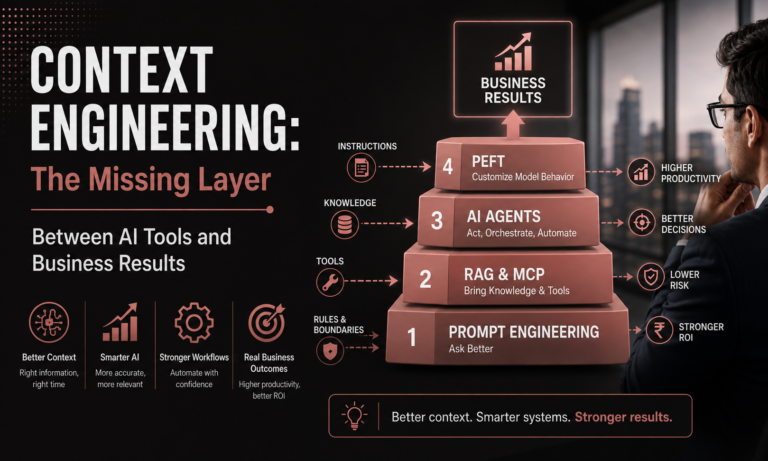
3. Context Engineering
Context Engineering is the broader practice of giving an AI system the information, instructions, knowledge and tools required to produce useful business outputs.
The LEADxAI model describes four practical levels:
Prompt Engineering → RAG + MCP → AI Agents → PEFT
Each level answers a different leadership question.
Also read: Context Engineering: The Missing Layer Between AI Tools and Business Results
Prompt Engineering
How do we communicate effectively with AI?
Better instructions, context, criteria and output requirements can improve model performance.
But prompting has a ceiling.
If the AI does not have the information required to answer a business question, better wording alone cannot solve the problem.
RAG
How does AI access enterprise knowledge?
Retrieval-Augmented Generation allows an AI application to retrieve relevant information from approved knowledge sources before generating an answer.
RAG is particularly useful for:
- internal knowledge assistants;
- HR policy systems;
- customer support;
- compliance;
- product documentation;
- enterprise search.
MCP and tool integration
What information and tools does the AI workflow need access to?
Enterprise AI increasingly needs to interact with systems rather than simply generate text.
That may involve CRM, ERP, ticketing, databases, APIs or other approved tools.
The leadership question should not be “Do we need MCP?”
It should be:
“What information and tools does this workflow actually need?”
AI Agents
Can AI perform multi-step work?
An agent may research, retrieve information, call tools, evaluate results and escalate exceptions.
But an AI agent is not a human employee.
Agents can fail because of incorrect reasoning, API errors, bad data, inappropriate tool selection or unexpected situations.
Enterprise agents therefore need:
- defined roles;
- permissions;
- KPIs;
- escalation rules;
- evaluation;
- monitoring;
- human ownership.
AI can perform the work. Accountability remains with the human owner.
PEFT and model customisation
Does the model itself need to behave differently?
Parameter-Efficient Fine-Tuning can be useful when a business needs specific model behaviour that cannot be achieved reliably through prompting, retrieval and workflow design alone.
The decision sequence should normally be:
Better instructions → RAG → tools → agents → model customisation
Not every enterprise needs every layer.
The simplest reliable architecture is usually the better starting point.
The 4 Levels of Enterprise Context Engineering
A central concept in the LEADxAI framework is Context Engineering: giving an AI system the information, instructions, knowledge and tools it needs to produce useful business outcomes.
The framework uses four levels:
Prompt Engineering → RAG + MCP → AI Agents → PEFT
These levels are not simply technical stages.
They represent different leadership decisions.
Also read: RAG vs AI Agents vs Fine-Tuning: What Should an Enterprise Build?
Level 1 — Prompt Engineering
How do we communicate effectively with AI?
Prompt Engineering is the starting point.
A good enterprise prompt can define:
- business context;
- objective;
- audience;
- constraints;
- decision criteria;
- required output;
- examples;
- quality requirements.
Instead of:
“Analyse this report.”
A stronger instruction might specify:
“Review this report from the perspective of a regional sales director. Identify the three largest revenue risks, quantify the evidence available, distinguish facts from assumptions, and return the result as a decision table.”
Better context can improve the usefulness of AI.
But prompting has a ceiling.
If the AI does not have the information required to answer a business question, better wording cannot solve the entire problem.
That leads to the next level.
Level 2 — RAG + MCP
How does AI access enterprise knowledge and tools?
Retrieval-Augmented Generation (RAG) allows an AI application to retrieve relevant information from external or organisational knowledge sources before generating an answer.
A simple analogy:
RAG is like giving AI the relevant company handbook before asking it a question about company policy.
Enterprise RAG can work with:
- policies;
- SOPs;
- product documentation;
- technical documentation;
- knowledge bases;
- approved business content;
- other authorised information sources.
The second part is MCP — Model Context Protocol.
MCP addresses the broader problem of connecting AI applications with external information and tools.
But the leadership question should not be:
“Do we need MCP?”
It should be:
“What information and tools does this workflow actually need?”
That keeps the business problem ahead of the technology.
The LEADxAI curriculum explicitly teaches leaders to evaluate whether an organisation needs Prompt Engineering, RAG, MCP or another approach rather than simply accepting a vendor’s architecture.
Level 3 — AI Agents
Can AI perform multi-step work?
Traditional Generative AI primarily responds to instructions.
An AI agent can be designed to perform a sequence of tasks using information and tools.
For example:
Research → retrieve information → analyse → use a business tool → produce result → evaluate → escalate
This creates significantly more potential value.
It also creates more potential failure points.
An agent can encounter:
- incomplete information;
- incorrect reasoning;
- API failures;
- tool errors;
- unexpected inputs;
- permission problems;
- loops;
- poor escalation decisions.
Therefore:
AI can perform work. Accountability does not transfer to AI.
The LEADxAI curriculum uses an AI Virtual Employee Framework to think about agent roles, KPIs, onboarding, performance review, iteration and a code of conduct.
A useful enterprise agent should therefore have:
- a defined role;
- a defined scope;
- measurable KPIs;
- controlled access;
- approved tools;
- escalation rules;
- evaluation;
- monitoring;
- human ownership.
Level 4 — PEFT and Model Customisation
When should an organisation customise the model itself?
Parameter-Efficient Fine-Tuning, or PEFT, can be considered when an organisation needs model behaviour that cannot be achieved reliably through prompting, retrieval and workflow design.
The important leadership decision is not:
“Can we fine-tune a model?”
It is:
“Is model customisation actually justified by the business requirement?”
A practical decision sequence is:
Better prompting → RAG → tools → agents → model customisation
Not every enterprise needs every layer.
The simplest architecture that reliably solves the problem is usually the better starting point.
What Are the Best Enterprise Generative AI Use Cases?
There is no universal list of “best” use cases.
A strong use case depends on:
- business impact;
- process volume;
- data availability;
- feasibility;
- adoption;
- risk;
- economics.
However, several enterprise patterns are worth evaluating.
Customer support
Generative AI can support:
- knowledge retrieval;
- response drafting;
- ticket classification;
- conversation summaries;
- escalation;
- next-best-action recommendations.
The important distinction is between generating an answer and completing a controlled customer-service workflow.
Sales
Potential applications include:
- account research;
- meeting preparation;
- proposal drafting;
- CRM summarisation;
- follow-up generation;
- sales-call analysis;
- opportunity qualification.
The important question is not:
“Can AI write sales emails?”
It clearly can.
The more valuable question is:
“Which part of the sales process can AI improve measurably?”
Finance
Enterprise GenAI can support:
- document analysis;
- management reporting;
- policy queries;
- variance explanations;
- financial narratives;
- repetitive analysis.
High-risk financial decisions should retain appropriate human review and governance.
Human Resources
Possible applications include:
- HR policy assistants;
- employee communication;
- job-description generation;
- learning content;
- workforce analysis;
- internal knowledge retrieval.
Access controls are particularly important when employee information is involved.
Operations
AI can assist with:
- SOP retrieval;
- incident summaries;
- quality documentation;
- process analysis;
- knowledge retrieval;
- workflow automation.
Operations use cases often provide a useful starting point because the underlying processes can have measurable cycle-time, quality or cost metrics.
Enterprise knowledge management
This is one of the clearest applications for RAG.
Large organisations often have information spread across:
- shared drives;
- policies;
- documentation;
- knowledge bases;
- CRM records;
- internal reports;
- product material.
The problem is often not a lack of information.
It is finding the right information at the right moment.
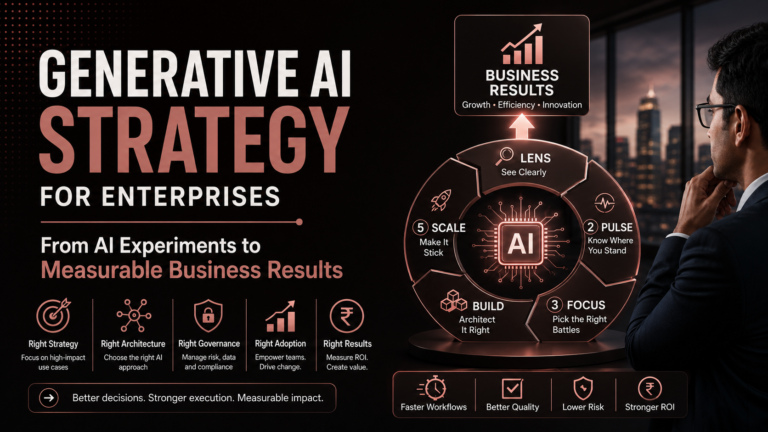
Also read: Generative AI Strategy for Enterprises: From AI Experiments to Measurable Business Results
How Should a Business Leader Choose an Enterprise AI Use Case?
Start with the business process.
Not the AI tool.
Ask:
“Where do we have a measurable business problem that AI could realistically improve?”
Use this screening framework.
| Question | What to look for |
| Is the process frequent? | High transaction volume |
| Is there measurable pain? | Cost, time, quality or delay |
| Is the information available? | Reliable and permissioned data |
| Is the process repeatable? | Defined workflow |
| Can AI add value? | Generation, retrieval or reasoning |
| Is the risk manageable? | Human oversight is possible |
| Can success be measured? | Baseline KPI exists |
| Can it scale? | Value extends beyond one person |
A useful prioritisation equation is:
Impact × Feasibility × Adoption ÷ Risk
The exact scoring model can vary, but the principle is consistent:
Do not build an AI project simply because the technology is impressive.
Build it because the business problem is worth solving.
What Is Enterprise AI Readiness?
Enterprise AI readiness means having the organisational conditions required to adopt and scale Generative AI responsibly.
It includes more than having an AI team.
Assess at least eight areas:
| Area | Leadership question |
| People | Do employees have the required skills? |
| Data | Is the required information available and usable? |
| Processes | Have we identified suitable workflows? |
| Technology | Can AI connect to required systems? |
| Security | Are data and access controls addressed? |
| Governance | Who owns AI decisions and risks? |
| Leadership | Are priorities aligned? |
| Measurement | Do we know what success looks like? |
The PULSE™ framework covers process mapping, data readiness, skills, security and compliance, and AI maturity.
A useful starting point is not:
“Are we AI-ready?”
but:
“Which specific workflow are we ready to improve with AI?”
How Do You Measure Enterprise Generative AI ROI?
This is where an AI programme becomes a business programme.
Do not measure success only through:
- number of prompts;
- number of users;
- number of licences;
- number of AI-generated documents.
Those are activity metrics.
Start with the existing process.
For example:
Before AI
- process time;
- cost per transaction;
- throughput;
- quality/error rate;
- employee effort.
After AI
Measure:
- time per transaction;
- throughput;
- quality;
- cost;
- escalation rate;
- adoption;
- revenue impact;
- risk reduction.
The LEADxAI AI ROI Engine follows four steps:
Metrics → Prioritise → Automate → Deploy & Track
The key question is:
“What business metric should change because we introduced AI?”
If that question has no clear answer, the AI business case is probably not ready.
What Are the Risks of Enterprise Generative AI?
Enterprise AI introduces risks that must be designed into the system rather than added after deployment.
Key risks include:
- inaccurate outputs;
- hallucinations;
- sensitive-data exposure;
- inappropriate access;
- weak evaluation;
- uncontrolled costs;
- over-automation;
- employee resistance;
- vendor dependency;
- unclear accountability.
A practical governance model should answer:
- What data can AI access?
- What data must it never access?
- What actions can AI perform?
- What requires human approval?
- How are outputs evaluated?
- How are failures recorded?
- Who owns the final decision?
For a broader risk-management reference, organisations can also use the NIST AI Risk Management Framework and its Generative AI Profile.
Why Do Enterprise AI Pilots Fail to Reach Production?
A successful demo is not the same thing as a successful enterprise deployment.
Projects often encounter problems when moving from proof of concept to production:
- data quality;
- integration;
- security;
- unclear ownership;
- poor adoption;
- unpredictable cost;
- inadequate evaluation;
- governance objections.
This creates the POC-to-production gap.
The lesson for leaders is simple:
A successful demo proves that something can work. It does not prove that it should be deployed at scale.
Before moving into production, ask:
Does the workflow work?
Is the data reliable?
Is the architecture appropriate?
Are the permissions correct?
Can the output be evaluated?
Can the economics be measured?
Who owns the result?
A Practical Enterprise Generative AI Implementation Framework
A sensible starting sequence is four stages.
Stage 1 — Understand
Assess:
- existing AI usage;
- current tools;
- business processes;
- data;
- skills;
- risks;
- leadership priorities.
Stage 2 — Prioritise
Identify candidate use cases and score them by:
Impact × Feasibility × Adoption ÷ Risk
Select a small number of strong candidates.
Stage 3 — Build
Choose the simplest appropriate architecture:
- Prompt Engineering;
- RAG;
- tool integration;
- AI agent;
- model customisation.
Do not introduce technical complexity simply because the technology exists.
Stage 4 — Measure
Track:
- baseline KPI;
- post-AI KPI;
- cost;
- quality;
- adoption;
- failure modes;
- governance requirements.
Then make a decision:
Scale. Improve. Pivot. Or stop.
Stopping an AI initiative that does not create sufficient value is not failure.
It is good capital allocation.
The Enterprise AI Leadership Model
Enterprise Generative AI is often presented as a technology story.
For a business leader, it is better understood as an operating-model question.
The full chain is:
Business problem → Use case → Context → Architecture → Governance → Adoption → KPI → Production
Break the chain at any point and the AI initiative becomes harder to scale.
This is why enterprise AI leadership requires working knowledge across several layers.
Leaders do not necessarily need to write the code.
They need to understand:
- what AI can realistically do;
- where it creates business value;
- what information it needs;
- when RAG makes sense;
- when an agent makes sense;
- when model customisation is justified;
- what the risks are;
- what it will cost;
- how success will be measured.
That is the decision layer of enterprise Generative AI.
10 Questions Every Business Leader Should Ask Before Approving Enterprise AI
- What business problem are we solving?
- What does the current process cost us?
- Which KPI should change?
- What information does the AI need?
- Where will that information come from?
- Do we need prompting, RAG, tools, an agent or model customisation?
- What is the simplest architecture that could work?
- What could go wrong?
- Who owns the outcome?
- What would make us stop the project?
If the team cannot answer these questions, the organisation may not have a sufficiently defined AI use case yet.
Not because AI is too difficult.
Because the problem has not been defined clearly enough.