How to Build an Enterprise GenAI Readiness Scorecard
Generative AI has moved from experimentation to an executive-level business priority.
Most large organizations have already tested ChatGPT, Microsoft Copilot, Gemini, Claude or other AI tools. Some have built internal copilots. Others are experimenting with Retrieval-Augmented Generation (RAG), AI agents and enterprise knowledge assistants.
But there is a more important question that often gets missed:
Is the organization actually ready to scale Generative AI?
- Having AI subscriptions is not the same as being AI-ready.
- Having a successful proof of concept is not the same as being production-ready.
And having employees who know how to write prompts is certainly not the same as having an enterprise AI capability.
A useful enterprise GenAI readiness scorecard gives leadership a structured way to answer these questions before committing more budget, technology or organizational effort.
The goal is not to produce an impressive AI maturity number.
The goal is to know what to do next.
What Is an Enterprise GenAI Readiness Scorecard?
An enterprise GenAI readiness scorecard is a structured framework for evaluating whether an organization has the capabilities required to adopt and scale Generative AI.
A good scorecard examines multiple dimensions rather than looking only at technology.
At minimum, assess:
- Leadership alignment
- Business processes
- AI use cases
- Data readiness
- Technology infrastructure
- AI skills
- Employee adoption
- Security
- Privacy and compliance
- Governance
- AI maturity
- Measurement and ROI
The output should answer four practical questions:
- Where are we ready today?
- Where are the gaps?
- What should we fix first?
- Which GenAI use cases should we pursue now?
That last question is critical.
An organization does not need to become “100% AI-ready” before doing anything.
In many cases, a company can identify a low-risk, high-value use case while simultaneously improving its readiness.
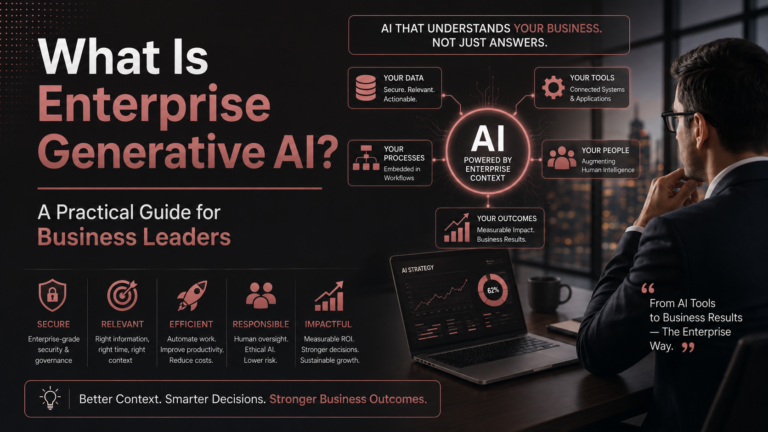
Also read: What Is Enterprise Generative AI? Definition, Use Cases, Architecture & Strategy
Why Do Enterprises Need a GenAI Readiness Assessment?
- The first wave of enterprise GenAI adoption was largely tool-driven.
- Employees received access to AI tools.
- Teams experimented with prompts.
- Innovation teams built prototypes.
- Leadership watched the demonstrations.
Then many organizations encountered the same problem:
The pilots looked promising, but scaling them was difficult.
The problem may have been:
- fragmented data;
- unclear ownership;
- poor data quality;
- security restrictions;
- inadequate AI skills;
- lack of evaluation;
- unclear ROI;
- weak adoption;
- regulatory concerns;
- integration complexity.
This is why readiness should be assessed before major scaling decisions, not after a project has already consumed significant resources.
Google’s current guidance also favors content that provides original, useful analysis rather than simply repeating information available elsewhere.
So this article takes a different approach: instead of simply defining AI readiness, it provides a practical scoring model.
The Enterprise GenAI Readiness Scorecard
A practical scorecard can use eight dimensions.
| Dimension | What it measures | Weight |
|---|---|---|
| Leadership & Strategy | Executive alignment and business priorities | 15% |
| Data Readiness | Quality, accessibility and governance of data | 15% |
| Process Readiness | Availability of suitable workflows | 15% |
| Technology | Infrastructure, platforms and integration | 10% |
| Skills & Workforce | AI capability and adoption | 15% |
| Security & Compliance | Risk, privacy and controls | 15% |
| Governance | Ownership, policies and accountability | 10% |
| Measurement & ROI | KPIs, economics and value tracking | 5% |
| Total | 100% |
The weights can be customized by industry.
For example, a heavily regulated financial organization may assign greater importance to security, privacy and governance.
A technology company may put more weight on engineering capability and infrastructure.
The important thing is to score consistently.
How to Score Each Dimension
Use a simple five-point scale.
| Score | Meaning |
|---|---|
| 1 | Not ready |
| 2 | Early / fragmented |
| 3 | Developing |
| 4 | Operational |
| 5 | Scaled / optimized |
This gives leadership a common language.
Instead of saying:
“Our AI maturity is pretty good.”
you can say:
“Our overall readiness is 3.1, but data governance is 2.0 and AI skills are 2.5.”
That is much more actionable.
1. Leadership & AI Strategy Readiness
The first question is not technical.
It is strategic:
Does leadership know why the organization wants to use GenAI?
AI projects become difficult when the business objective is unclear.
Assess whether:
- senior leadership has defined AI priorities;
- AI initiatives connect to business strategy;
- executives understand GenAI capabilities and limitations;
- there is an identified executive sponsor;
- business units know their AI priorities;
- AI investment criteria exist;
- leadership understands risk and governance;
- AI decisions are based on measurable outcomes.
Score yourself
| Score | Description |
|---|---|
| 1 | No common AI direction |
| 2 | Experiments exist independently |
| 3 | Leadership has broad AI priorities |
| 4 | AI roadmap is connected to business strategy |
| 5 | AI is embedded in strategic planning and investment decisions |
2. Data Readiness
This is one of the most important dimensions.
An AI model cannot compensate for unusable enterprise information.
The LEADxAI PULSE™ framework therefore treats data readiness tiers as a core part of the GenAI readiness assessment:
- T1: Data works as-is
- T2: Data requires cleanup
- T3: Data requires infrastructure or deeper preparation
For each important data source, assess:
- quality;
- completeness;
- consistency;
- accessibility;
- freshness;
- ownership;
- security;
- metadata;
- standardization;
- permissions.
Example
| Data condition | Readiness |
|---|---|
| Clean, structured and governed | High |
| Useful but inconsistent | Medium |
| Fragmented across systems | Low |
| Unknown ownership | Low |
| Poor quality / outdated | Very low |
Important question
Don’t ask:
“Do we have enough data?”
Ask:
“Can an AI system safely retrieve the right information at the moment it needs it?”
That is a much better enterprise readiness question.
3. Process Readiness
Not every business process is a good GenAI candidate.
The strongest candidates often contain combinations of:
- high transaction volume;
- repetitive work;
- large amounts of unstructured information;
- manual analysis;
- document-heavy workflows;
- predictable outputs;
- measurable business outcomes.
The PULSE™ framework explicitly recommends mapping high-volume, repetitive and data-heavy workflows during readiness assessment.
Example process scorecard
| Process | Volume | Repetition | AI feasibility | Business impact |
|---|---|---|---|---|
| Customer support | High | High | High | High |
| Contract review | Medium | High | High | High |
| Strategic planning | Low | Low | Medium | High |
| Payroll calculation | High | High | Low/Medium | High |
The purpose is not to automate everything.
It is to identify where AI can create meaningful value.
4. Technology Readiness
Technology readiness goes beyond having an LLM subscription.
Assess:
- cloud infrastructure;
- APIs;
- enterprise applications;
- data platforms;
- identity systems;
- integration capabilities;
- observability;
- model access;
- AI development capability;
- deployment environment.
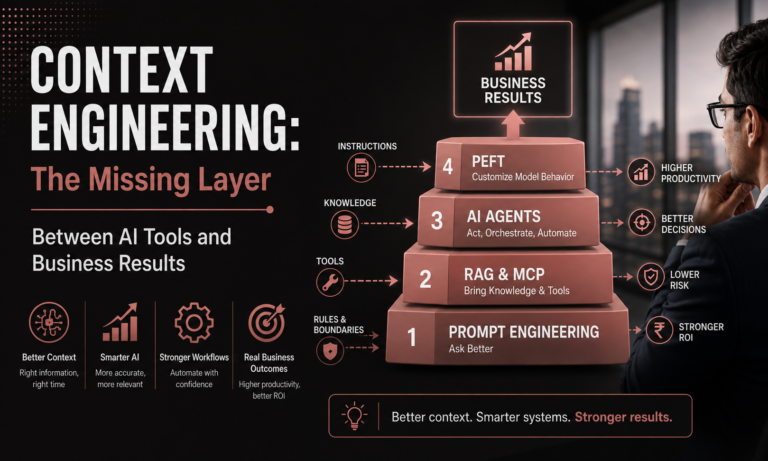
Also consider the organization’s position on the Context Engineering maturity ladder:
Level 1 → Prompt Engineering
Level 2 → RAG + MCP
Level 3 → AI Agents
Level 4 → PEFT
This model helps leaders decide how much AI capability is actually required rather than jumping directly to complex architecture.
A company that is still struggling with basic data access probably does not need to start with sophisticated multi-agent architecture.
Also read: Generative AI Strategy for Enterprises: From AI Experiments to Measurable Business Results
5. Skills & Workforce Readiness
Technology does not create adoption by itself.
Employees need enough knowledge to use AI appropriately.
Assess the workforce across several categories:
| Employee group | Capability to assess |
|---|---|
| Executives | AI strategy and decision-making |
| Managers | Use-case identification and adoption |
| Business users | Practical AI usage |
| Data teams | AI/RAG/evaluation capability |
| IT teams | Integration and deployment |
| Security | AI risk and security |
| Legal | Privacy and compliance |
| AI champions | Internal enablement |
The LEADxAI model deliberately distinguishes between builders, prompters and resistors when considering the skills gap.
That is useful because the question is not simply:
“How many people completed AI training?”
A better question is:
“Can our people make good AI decisions in the context of their actual work?”
6. Security & Compliance Readiness
This dimension can determine whether an AI initiative ever reaches production.
Assess:
- data classification;
- PII handling;
- access controls;
- authentication;
- authorization;
- vendor risk;
- data retention;
- auditability;
- model security;
- prompt injection risks;
- data leakage;
- regulatory requirements.
For organizations operating in India, the assessment should also consider applicable privacy and data-protection obligations.
The LEADxAI curriculum explicitly treats security, PII and RBAC as non-negotiable gates in enterprise GenAI architecture.
Readiness question
If an employee enters sensitive information into an AI system tomorrow, do we know exactly what happens to that information?
If the answer is unclear, the organization has a readiness gap.
7. AI Governance Readiness
Governance answers:
Who is accountable?
A mature enterprise should have defined:
- AI ownership;
- approval processes;
- acceptable-use policies;
- risk classification;
- vendor evaluation;
- model evaluation;
- incident handling;
- human oversight;
- monitoring;
- audit processes.
Governance should not appear only after a pilot succeeds.
The LEADxAI framework deliberately moves legal, compliance and security considerations earlier into use-case selection, rather than waiting until architecture is already built.
That is an important shift.
Move governance left.
Also read: AI Governance & Responsible AI for CXOs | Sudhanshu Saxena
8. Measurement & ROI Readiness
This is where many AI programs become vague.
A readiness scorecard should ask:
- Do we have baseline KPIs?
- Can we measure productivity?
- Can we measure quality?
- Can we calculate AI operating cost?
- Can we measure adoption?
- Can we measure time saved?
- Can we measure revenue impact?
- Can we measure risk reduction?
A useful GenAI business case might track:
| KPI | Before AI | Target |
|---|---|---|
| Processing time | 60 min | 20 min |
| Manual effort | 8 steps | 3 steps |
| Error rate | 7% | <3% |
| Cost/transaction | ₹X | ₹Y |
| Adoption | 0% | 70% |
The exact KPI depends on the use case.
The principle does not.
If you cannot define how success will be measured, you are not ready to scale the investment.
The Enterprise GenAI Readiness Score
Once each dimension has been scored from 1–5, calculate the weighted result.
For example:
| Dimension | Score | Weight | Weighted score |
|---|---|---|---|
| Leadership | 4 | 15% | 0.60 |
| Data | 2 | 15% | 0.30 |
| Processes | 4 | 15% | 0.60 |
| Technology | 3 | 10% | 0.30 |
| Skills | 2 | 15% | 0.30 |
| Security | 4 | 15% | 0.60 |
| Governance | 3 | 10% | 0.30 |
| ROI | 2 | 5% | 0.10 |
| Overall | 100% | 3.10 / 5 |
The organization therefore has a readiness score of:
3.1 / 5 — Developing
But the score alone is not the answer.
The real insight is:
Data + skills + ROI are holding the organization back.
That tells leadership where to act.
How to Interpret the Score
Use five maturity bands.
| Score | Readiness level | Meaning |
|---|---|---|
| 1.0–1.9 | Nascent | Build foundations |
| 2.0–2.9 | Emerging | Run controlled experiments |
| 3.0–3.5 | Developing | Scale selected use cases |
| 3.6–4.4 | Advanced | Industrialize AI capability |
| 4.5–5.0 | Scaled | Optimize and continuously evolve |
Do not treat these boundaries as universal industry standards.
They are a management tool.
The purpose is to create a consistent decision framework.
Your Score Can Be High and Still Hide a Serious Problem
This is one of the most important parts of a readiness scorecard.
Imagine:
Overall score = 4.0
That looks excellent.
But suppose:
- Leadership = 5
- Technology = 5
- Skills = 4
- Data = 2
- Security = 4
The organization may have excellent technology and enthusiastic leadership.
But if the data required by the AI applications is unreliable, the enterprise still has a major bottleneck.
Therefore:
Never manage the average score alone. Manage the weakest critical capability.
This is why the scorecard should display both:
Overall readiness
and
Dimension-level readiness.
The GenAI Readiness Heatmap
A simple red-amber-green view makes the assessment easier for leadership teams.
| Dimension | Score | Status |
|---|---|---|
| Leadership | 4.2 | 🟢 Ready |
| Data | 2.1 | 🔴 Gap |
| Processes | 3.8 | 🟢 Ready |
| Technology | 3.4 | 🟠 Developing |
| Skills | 2.5 | 🟠 Developing |
| Security | 4.0 | 🟢 Ready |
| Governance | 3.1 | 🟠 Developing |
| ROI | 2.2 | 🔴 Gap |
This immediately changes the executive conversation.
Instead of:
“Should we invest more in GenAI?”
the conversation becomes:
“Our use-case pipeline is strong, but data and ROI measurement need attention before we scale.”
That is a much more useful boardroom discussion.
The Five Levels of Enterprise GenAI Maturity
The scorecard should also produce a broader maturity classification.
Level 1 — Experimenting
The organization is primarily using consumer AI tools.
Typical characteristics:
- individual experimentation;
- no common policy;
- disconnected AI tools;
- limited governance;
- little measurement.
Level 2 — Exploring
Teams have begun identifying use cases.
Characteristics:
- departmental experiments;
- early AI policies;
- initial training;
- small pilots;
- early data discussions.
Level 3 — Developing
The organization has moved beyond isolated experiments.
Characteristics:
- prioritized use-case portfolio;
- RAG or enterprise data initiatives;
- AI governance beginning to mature;
- defined KPIs;
- structured training;
- production pilots.
Level 4 — Scaling
AI is becoming part of operating processes.
Characteristics:
- multiple production use cases;
- standardized architecture;
- governance;
- AI champions;
- measurement;
- reusable patterns;
- stronger enterprise integration.
Level 5 — AI-Native / Optimizing
AI is embedded into how the organization operates.
Characteristics:
- continuous AI experimentation;
- mature governance;
- strong internal capability;
- AI-enabled workflows;
- measurable business outcomes;
- continuous model/process optimization.
The LEADxAI framework similarly incorporates GenAI maturity scoring from Level 1–5 within PULSE™.
Also read: Data Governance & GDPR for AI and Analytics – Sudhanshu Saxena
What Should You Do After the Assessment?
The scorecard should never end with:
“Congratulations. Your company scored 3.2.”
That is not useful.
The assessment should lead to an action plan.
A practical sequence is:
Step 1 — Diagnose
Identify readiness gaps.
Step 2 — Prioritize
Find the highest-value AI opportunities.
Step 3 — Design
Choose the appropriate architecture.
Step 4 — Deploy
Run controlled pilots and measure outcomes.
Step 5 — Scale
Create governance, capability and operating rhythms.
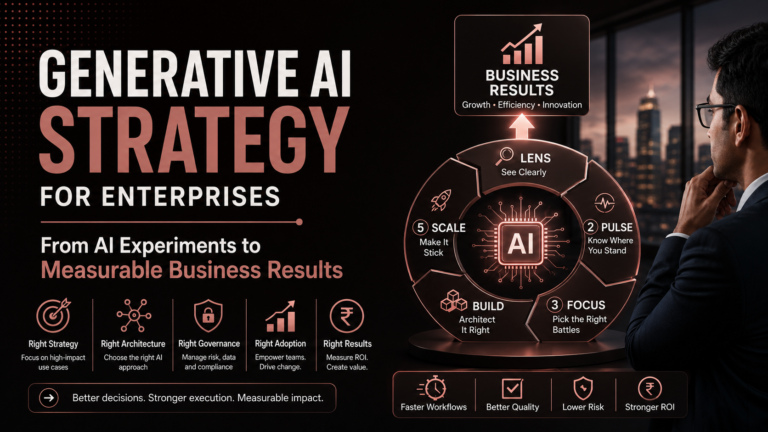
This maps directly to the LEADxAI transformation sequence:
LENS → PULSE → FOCUS → BUILD → SCALE
where PULSE produces the GenAI Readiness Scorecard, FOCUS produces the prioritized use-case roadmap, BUILD addresses architecture and production, and SCALE establishes governance and ongoing measurement.
GenAI Readiness Is Not the Same as AI Adoption
This distinction deserves attention.
An organization may have:
High AI adoption + low AI readiness
For example:
Employees use ChatGPT extensively, but:
- there is no policy;
- sensitive information is being shared;
- data is fragmented;
- nobody owns AI governance;
- ROI is unknown.
That is AI usage, not necessarily enterprise AI maturity.
Conversely:
High readiness + low adoption
can also occur.
The company may have:
- excellent infrastructure;
- strong governance;
- good data;
- trained employees;
but nobody is actually using the systems.
That creates a different problem:
adoption.
The scorecard should therefore distinguish between capability readiness and actual usage.
Also read: Generative AI & RAG Explained – Sudhanshu Saxena’s Enterprise Approach
The 20-Question Enterprise GenAI Readiness Checklist
For a quick diagnostic, ask these questions.
Strategy
- Do executives agree on why the organization needs GenAI?
- Is there a defined AI strategy?
- Is there an executive sponsor?
Data
- Do we know which data AI applications need?
- Is that data accessible?
- Is the data sufficiently clean and governed?
Processes
- Have we mapped high-value workflows?
- Can we identify repetitive, information-heavy processes?
- Are the outcomes measurable?
Technology
- Can our systems integrate with AI?
- Can we provide secure access to enterprise knowledge?
- Can we evaluate and monitor AI applications?
People
- Do leaders understand AI well enough to make decisions?
- Are business users trained?
- Do we have technical AI capability?
Security
- Is sensitive data protected?
- Are access controls defined?
Governance
- Is there clear AI ownership?
- Is there an AI usage policy?
Economics
- Can we calculate the business value and operating cost of each priority use case?
If most answers are “no,” the organization is not necessarily failing.
It simply has a readiness backlog.
And that backlog can be prioritized.
A Better Way to Think About Enterprise AI Readiness
The wrong mindset is:
“We need to become AI-ready.”
That sounds like a giant transformation project.
A better mindset is:
“What must be ready for the next AI use case we want to deploy?”
For example:
If the next use case is an internal knowledge assistant, the critical requirements may be:
- document quality;
- retrieval;
- permissions;
- evaluation;
- security.
If the next use case is an AI sales agent, the requirements may include:
- CRM integration;
- customer data;
- tool permissions;
- workflow orchestration;
- human approval;
- monitoring.
Readiness is therefore use-case dependent.
This is why the scorecard should connect readiness assessment to use-case prioritization rather than treating maturity as an abstract corporate badge.
Enterprise GenAI Readiness Scorecard Template
You can use this simplified version as a starting point.
| Area | Key question | Score 1–5 | Gap | Next action |
|---|---|---|---|---|
| Leadership | Is AI aligned with strategy? | |||
| Data | Is required data usable? | |||
| Processes | Are suitable workflows identified? | |||
| Technology | Can AI integrate with systems? | |||
| Skills | Do teams have required capability? | |||
| Security | Can AI operate safely? | |||
| Governance | Is accountability defined? | |||
| ROI | Can value be measured? |
What a 90-Day GenAI Readiness Roadmap Can Look Like
Once the scorecard is complete, translate it into action.
| Period | Focus | Deliverable |
|---|---|---|
| Days 1–30 | Diagnose | Readiness assessment + gap analysis |
| Days 31–60 | Prioritize | Use-case portfolio + business cases |
| Days 61–90 | Prepare | Architecture, governance and pilot plan |
This is more useful than spending three months creating a generic AI strategy document.
The LEADxAI 100-Day transformation model follows a similar sequence: DIAGNOSE → DESIGN → DEPLOY → SUSTAIN, with LENS/PULSE informing diagnosis, FOCUS driving prioritization, BUILD handling deployment, and SCALE establishing governance and the longer-term roadmap.
Enterprise GenAI Readiness: The Biggest Mistakes to Avoid
Scoring only technology
AI readiness is not an infrastructure checklist.
People, processes, governance and business value matter just as much.
Treating training completion as AI readiness
Completing a two-hour AI course does not mean an employee can use AI safely and effectively in a business workflow.
Ignoring data
If the information environment is poor, the AI system will inherit the problem.
Measuring pilots instead of outcomes
A successful POC is evidence that something can work.
It is not evidence that the business case works.
Giving every department the same scorecard
A bank, manufacturer, healthcare organization and software company will have different readiness priorities.
Waiting for perfect readiness
You do not need perfect readiness before beginning.
You need enough readiness for the specific use case and risk level.
Also read: AI Agents in the Enterprise: What They Can Actually Do – and Where They Fail
How AI Readiness Connects to Context Engineering
Enterprise AI capability is not one technology.
It is a progression.
The LEADxAI Context Engineering™ model describes four levels:
| Level | Capability | Business question |
|---|---|---|
| 1 | Prompt Engineering | Can we get better results through better instructions? |
| 2 | RAG + MCP | Does AI need enterprise knowledge and tools? |
| 3 | AI Agents | Does AI need to perform multi-step work? |
| 4 | PEFT | Does the model itself need deeper customization? |
This gives the readiness assessment an important architectural dimension.
A company shouldn’t jump from:
“Employees use ChatGPT”
straight to:
“Let’s build autonomous AI agents.”
The right question is:
What capability does this business problem actually require?
That is a much more mature way to approach enterprise GenAI.