RAG vs AI Agents vs Fine-Tuning: What Should an Enterprise Build?
RAG, AI agents and fine-tuning solve different enterprise problems. RAG gives an AI model access to relevant knowledge; AI agents allow AI to perform multi-step tasks using tools; fine-tuning changes how a model behaves. For most enterprises, the right choice is not the most advanced technology—it is the simplest architecture that reliably solves the business problem.
That sounds straightforward.
In practice, it is one of the most important decisions an enterprise AI team has to make. A team wants to build an internal knowledge assistant. Someone recommends RAG. Another team wants an autonomous workflow. Someone says, “We need an AI agent.”
Then someone asks:
“Why don’t we fine-tune the model?”
The conversation quickly becomes technical.
But the first question should not be technical.
It should be:
What does the business actually need AI to know, access, do or behave differently?
That question gives us a much better way to choose between RAG, AI agents and fine-tuning.
RAG vs AI Agents vs Fine-Tuning: What is the difference?
Here is the simplest enterprise-level distinction:
| Technology | Primary purpose | What it changes | Best suited for |
|---|---|---|---|
| RAG | Give AI relevant knowledge | What AI can access | Enterprise knowledge, policies, documents |
| AI Agents | Let AI perform work | What AI can do | Multi-step workflows and tool use |
| Fine-Tuning / PEFT | Customise model behaviour | How AI behaves | Specialised behaviour or task patterns |
Think of the three questions this way:
RAG:
“How do we give AI the right information?”
AI Agent:
“How do we let AI perform the work?”
Fine-Tuning:
“How do we change the model’s behaviour?”
That distinction is more useful for a business leader than starting with model architecture.
Which should an enterprise build?
If you are deciding today, use this sequence:
- Need better instructions? → Prompt Engineering
- Need company knowledge? → RAG
- Need access to enterprise tools? → MCP / tool integration
- Need AI to perform a multi-step workflow? → AI Agent
- Need specialised model behaviour that the above cannot adequately provide? → Fine-Tuning / PEFT
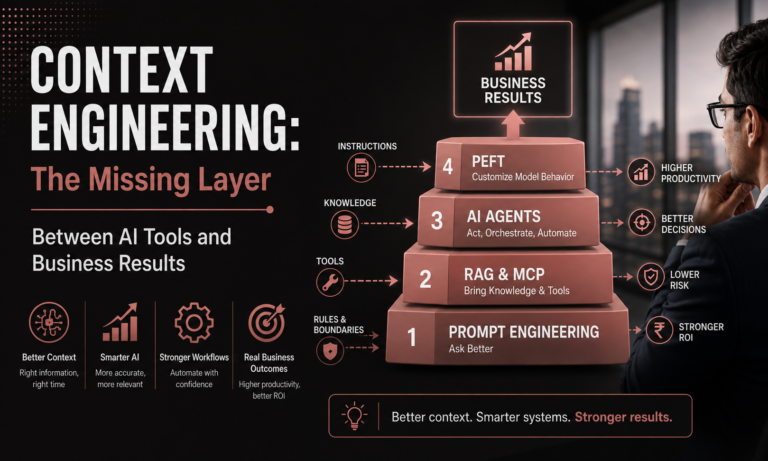
This is the core of the Context Engineering™ model used in LEADxAI. The framework treats these capabilities as a progression rather than isolated technologies.
The important word is progression.
It does not mean that every enterprise should eventually reach fine-tuning.
It means that leaders should understand what additional capability each layer provides.
What is RAG in enterprise AI?
Retrieval-Augmented Generation (RAG) is an architecture that allows an AI system to retrieve relevant information from an external knowledge source and provide that information as context to a language model before generating an answer.
In simple terms:
RAG gives the AI access to the company’s relevant knowledge without requiring that knowledge to be embedded into the model itself.
Imagine an employee asks:
“What is our current travel reimbursement policy for international travel?”
A general-purpose AI model may know what travel reimbursement policies generally look like.
But it does not automatically know your company’s current policy.
A RAG system can retrieve the relevant internal policy and provide it to the model.
The workflow becomes:
Question → Retrieve relevant information → Add context → Generate answer
This makes RAG particularly useful for enterprise knowledge applications.
When should an enterprise use RAG?
RAG is usually worth considering when:
- the AI needs access to proprietary information;
- information changes frequently;
- the organisation has a large document base;
- answers need to be grounded in company knowledge;
- users need source-aware responses;
- retraining the model every time information changes would be impractical.
Typical applications include:
| Enterprise function | RAG use case |
|---|---|
| HR | Employee policy assistant |
| Finance | Finance policy and reporting assistant |
| Legal | Contract and policy knowledge assistant |
| Customer Support | Product and troubleshooting knowledge |
| Sales | Product, pricing and proposal knowledge |
| Operations | SOP and process assistant |
| Compliance | Regulatory and policy retrieval |
Sudhanshu’s existing Generative AI & RAG resource similarly positions RAG around enterprise knowledge copilots, document Q&A, HR policy assistants and compliance applications.
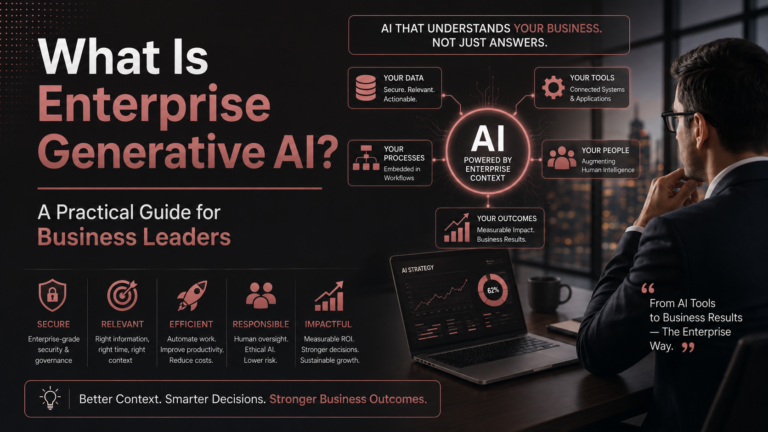
Related reading: What Is Enterprise Generative AI? A Practical Guide for Business Leaders
What RAG does not solve
This is where many enterprise AI projects go wrong.
RAG gives an AI system knowledge. It does not automatically give it:
- permission to perform actions;
- access to every enterprise system;
- a reliable multi-step workflow;
- autonomous decision-making;
- specialised model behaviour.
For example, suppose an HR assistant can retrieve the company’s leave policy.
It can answer:
“How many days of parental leave are available?”
But that does not mean it can:
- check the employee’s leave balance;
- determine eligibility;
- submit the leave request;
- update the HR system;
- notify the manager.
That is where the architecture starts moving towards tools, orchestration and agents.
What is an AI agent?
An AI agent is an AI system designed to pursue a goal through multiple steps, potentially using tools, retrieving information, taking actions and responding to changing conditions.
The simplest distinction is:
Generative AI answers. Agentic AI acts.
An ordinary AI interaction might look like:
Question → Answer
An agentic workflow might look like:
Goal → Plan → Retrieve → Use tools → Act → Check → Escalate
That is a fundamentally different enterprise capability.
When should an enterprise use an AI agent?
Consider an agent when the workflow requires:
- multiple steps;
- decisions between steps;
- access to business systems;
- tool calls or API interactions;
- conditional logic;
- repeated execution;
- defined permissions;
- escalation to humans when something goes wrong.
For example, consider customer support.
A conventional AI assistant might:
Draft a response to a customer.
An AI agent could potentially:
- Read the customer request.
- Identify the issue.
- Retrieve the relevant policy.
- Check the customer’s account.
- Determine the appropriate action.
- Create or update a support ticket.
- Draft the response.
- Escalate an exception.
That is why enterprise agents require more than a good prompt.
What does an enterprise AI agent need?
A useful way to think about an enterprise agent is through four components:
| Component | Purpose |
|---|---|
| Instructions | Defines role, objective and behaviour |
| Knowledge | Provides relevant enterprise information |
| Tools | Allows interaction with business systems |
| Rules & boundaries | Controls permissions, escalation and actions |
This connects directly with Context Engineering™.
At the agent level, AI needs more than instructions.
It needs the right context, knowledge, tools and boundaries.
The LEADxAI curriculum teaches this progression and explicitly covers RAG, MCP, agent architectures, tool use and enterprise decision-making.
Why AI agents are not simply “better RAG”
This is an important distinction.
RAG answers a knowledge problem.
Agents address a workflow problem.
For example:
RAG
“What is our refund policy?”
The system retrieves the relevant policy and answers.
Agent
“Process this customer’s refund if they are eligible.”
Now the system may need to:
- retrieve the policy;
- check the customer’s order;
- calculate eligibility;
- call the refund system;
- record the transaction;
- notify the customer;
- escalate exceptions.
The second problem requires action, not just retrieval.
What is fine-tuning in enterprise AI?
Fine-tuning involves adapting a pre-trained model using task-specific training data so that its behaviour becomes better suited to a particular requirement.
PEFT, or Parameter-Efficient Fine-Tuning, provides methods for adapting models without updating every parameter of the base model.
One common technique is LoRA.
But there is a critical enterprise misconception:
Fine-tuning is not simply another way of putting company documents into an AI model.
If the problem is:
“The model does not know our latest HR policy.”
RAG may be the more natural solution.
If the problem is:
“The model needs to consistently behave in a particular specialised way.”
Fine-tuning may deserve consideration.
Sudhanshu’s curriculum makes this distinction explicitly: RAG is for facts; PEFT is for behaviour.
You can also explore the dedicated LLM Fine-tuning, LoRA and PEFT resource.
When should an enterprise consider fine-tuning?
Fine-tuning may make sense when the organisation has a strong need for specialised model behaviour.
Potential examples include:
- consistent specialised output patterns;
- domain-specific classification;
- highly structured responses;
- specialised language or terminology;
- repeated task-specific behaviour;
- a sufficiently strong training dataset;
- a clear evaluation methodology.
But there should be a decision gate before fine-tuning.
Ask:
Can better prompting solve it?
If yes, start there.
Then ask:
Does the model need additional enterprise knowledge?
If yes, investigate RAG.
Then:
Does it need access to enterprise systems?
Consider tools or MCP.
Then:
Does it need to execute a multi-step workflow?
Consider an agent.
Only then ask:
Does the model itself need specialised behaviour?
If yes, investigate PEFT or fine-tuning.
RAG vs AI Agents vs Fine-Tuning: Enterprise Decision Matrix
This is the table I would put near the middle of the article because it gives a business leader a decision framework rather than another technology definition.
| Requirement | Prompt | RAG | AI Agent | Fine-Tuning |
|---|---|---|---|---|
| Better instructions | ✓ | |||
| Company knowledge | ✓ | ✓ | ||
| Frequently changing information | ✓ | ✓ | ||
| Document Q&A | ✓ | |||
| Tool access | + MCP | ✓ | ||
| Multi-step workflow | ✓ | |||
| Autonomous actions | ✓ | |||
| Specialised behaviour | ✓ | |||
| Consistent task behaviour | ✓ | |||
| Change knowledge frequently | ✓ | ✓ | ||
| Need human escalation | ✓ | ✓ | ||
| Simplest starting point | ✓ | ✓ |
The important point is that these are not mutually exclusive technologies.
An enterprise agent may use:
Prompt Engineering + RAG + MCP + Agent orchestration
And a specialised enterprise system could potentially use:
Prompt + RAG + Tools + Agent + PEFT
The architecture should follow the business requirement.
RAG vs Fine-Tuning: What is the difference?
This is probably the most common enterprise question.
The simplest explanation is:
RAG changes the information available to the model. Fine-tuning changes model behaviour.
Imagine an organisation wants an AI assistant for internal policies.
Scenario A: Policies change frequently
The company updates policies every month.
RAG is usually more natural because the system can retrieve the latest documents.
Scenario B: The model repeatedly produces the wrong output format
The organisation has thousands of high-quality examples demonstrating exactly how the task should be performed.
Fine-tuning may be worth evaluating.
The distinction:
RAG → “Here is the information you need.”
Fine-tuning → “Here is how we want you to behave.”
AI Agent vs RAG: Which should you choose?
Ask one question:
Does the system only need to retrieve and explain information, or does it need to perform work?
If it only needs to answer questions from enterprise knowledge:
Start with RAG.
If it needs to execute a multi-step workflow:
Consider an AI agent.
For example:
Knowledge assistant
“Find our procurement policy and explain the approval limits.”
RAG
Procurement agent
“Review this purchase request, check policy, verify the approval threshold, create the purchase request and escalate if required.”
Agent + RAG + tools
That distinction is central to enterprise architecture.
What should an enterprise build first?
In most cases, do not start with the most sophisticated architecture.
Start with the smallest architecture that can prove the business case.
A sensible progression is:
Stage 1 — Prompt
Can the workflow be improved with better instructions?
↓
Stage 2 — RAG
Does the AI need proprietary or frequently changing information?
↓
Stage 3 — Tools / MCP
Does the AI need access to enterprise systems?
↓
Stage 4 — Agent
Does it need to perform multiple steps or actions?
↓
Stage 5 — PEFT
Does the model itself need specialised behaviour?
This is essentially the Context Engineering™ maturity ladder.
The objective is not to climb the ladder for its own sake.
The objective is to reach the level required by the business problem.
A practical enterprise architecture example
Imagine a company wants to build an AI employee-support system.
The business requirement is:
“Employees should be able to ask HR questions and get accurate answers based on current company policies.”
Version 1
LLM + Prompt
The model answers general questions.
Problem: It does not reliably know company policy.
Version 2
LLM + RAG
The model retrieves current HR policies.
Now it can answer questions based on internal information.
Version 3
LLM + RAG + Tools
The system can retrieve policy information and check employee-specific data.
Version 4
LLM + RAG + Tools + Agent
The system can perform a workflow:
Question → Check policy → Check employee data → Determine next step → Execute permitted action → Escalate if necessary
Version 5
Add PEFT only if there is a demonstrated behavioural requirement
This is a much more defensible architecture journey than starting by asking:
“Which AI technology should we buy?”
The enterprise AI architecture should start with the workflow
A mature enterprise AI stack can be thought of as:
Data → Model → Orchestration → Interface → Governance
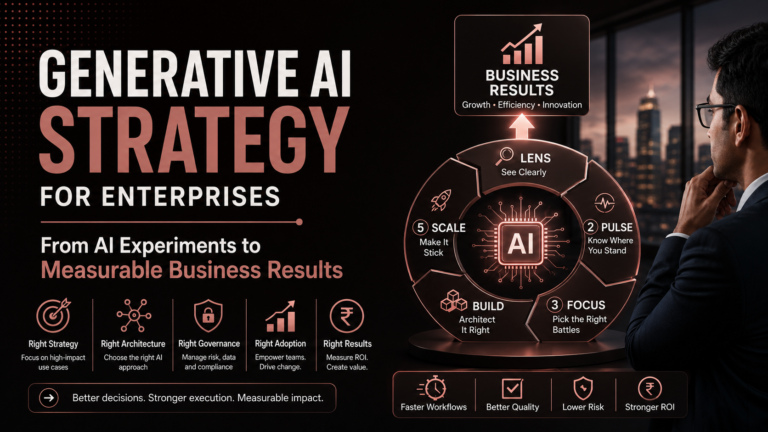
The BUILD™ framework uses this kind of architecture thinking and combines it with cost modelling, build-vs-buy decisions, RAG, agents, MCP, security, PII, RBAC and POC-to-production checks.
The mistake is to focus only on the model.
The model is one layer.
The business workflow is the system.
What does RAG, AI Agents and Fine-Tuning cost?
There is no universal price.
Costs depend on:
- model selection;
- volume of usage;
- data preparation;
- retrieval infrastructure;
- vector/search infrastructure;
- tool integrations;
- orchestration;
- engineering;
- evaluation;
- monitoring;
- security;
- governance;
- maintenance.
This is why enterprise AI economics should be considered before architecture is locked.
The LEADxAI BUILD™ framework explicitly includes token economics, unit economics and the question of when to prompt, use RAG, use an agent or fine-tune.
A technically impressive architecture can still be a poor business decision if the unit economics do not work.
What are the biggest mistakes enterprises make?
1. Fine-tuning too early
Fine-tuning sounds sophisticated.
Sophistication is not the objective.
Business value is.
2. Building RAG when the workflow actually needs actions
If users need AI to update systems, create tickets, trigger workflows or perform multi-step tasks, retrieval alone may not be sufficient.
3. Building agents for simple questions
If the problem is simply:
“Find the relevant company policy.”
An agent may introduce unnecessary complexity.
A well-designed RAG system may be enough.
4. Ignoring failure modes
An AI agent can:
- call the wrong tool;
- misunderstand an instruction;
- encounter an API failure;
- loop;
- produce an incorrect result;
- take an action that requires human judgement.
The LEADxAI curriculum deliberately includes “unhappy path” agent demonstrations because leaders need to understand where low-code and agentic systems can break.
5. Measuring technology instead of business outcomes
A successful POC is not:
“The agent worked.”
The better question is:
“Did the workflow improve?”
Measure:
- time;
- quality;
- cost;
- accuracy;
- throughput;
- adoption;
- error rate;
- customer impact;
- revenue or cost impact where relevant.
This connects directly to the AI ROI Engine: Metrics → Prioritise → Automate → Deploy & Track.
The 7-question enterprise AI decision filter
Before approving a RAG, agent or fine-tuning project, ask:
1. What business problem are we solving?
Not:
“What AI capability do we want?”
2. What does the AI need to know?
If the answer is proprietary or frequently changing information, investigate RAG.
3. What does the AI need to access?
If it needs business systems, investigate tools/MCP.
4. What does the AI need to do?
If it needs multi-step execution, consider an agent.
5. What behaviour needs to change?
If the issue is model behaviour rather than missing information, investigate PEFT/fine-tuning.
6. What is the baseline?
Without a baseline, ROI is difficult to prove.
7. What is our kill criterion?
Define the condition under which the organisation will stop, pivot or scale the initiative.
That final question is often missing.
The FOCUS™ and BUILD™ frameworks deliberately include kill criteria so that enterprises can stop weak initiatives before they consume disproportionate resources.
The real enterprise question is not RAG vs Agents vs Fine-Tuning
It is:
What does the business problem require AI to know, access, do and behave like?
That produces a much better decision model:
| Enterprise need | Right question |
|---|---|
| Knowledge | What does AI need to know? |
| Tools | What systems does AI need to access? |
| Action | What work does AI need to perform? |
| Behaviour | How must AI behave differently? |
| Economics | Can we deliver that capability at acceptable unit cost? |
| Governance | What should AI never be allowed to do? |
| Accountability | Who owns the outcome? |
This is the decision layer that business leaders need.
Not every leader needs to build RAG.
Not every organisation needs agents.
And very few enterprise problems justify fine-tuning simply because it is technically possible.
Context Engineering: The missing layer between AI tools and business results
The decision becomes clearer when these technologies are viewed as layers of Context Engineering™.
The four-level model is:
| Level | Technology | Leader’s question |
|---|---|---|
| 1 | Prompt Engineering | How do I communicate with AI effectively? |
| 2 | RAG + MCP | How does AI access our knowledge and tools? |
| 3 | AI Agents | Can AI perform multi-step work? |
| 4 | PEFT | When should we customise the model? |
The LEADxAI programme uses this four-pillar model as its capability spine for helping leaders understand AI decisions without needing to become developers.
Related reading: Context Engineering: From AI Tools to Business Results
RAG vs AI Agents vs Fine-Tuning: Final verdict
If an enterprise needs knowledge, start by evaluating RAG.
If it needs actions, evaluate tools and AI agents.
If it needs specialised behaviour, evaluate fine-tuning or PEFT.
And before all three, ask whether better prompting and workflow design can solve the problem more simply.
The best enterprise architecture is rarely the one with the most components.
It is the one that:
solves the business problem → works reliably → can be governed → has acceptable economics → gets adopted.
That is the difference between experimenting with AI and building an enterprise AI capability.