RAG for Enterprises: When Does Retrieval-Augmented Generation Actually Make Sense?
RAG makes sense when an enterprise AI application needs to answer from specific, proprietary, current or frequently changing information that is not reliably contained in the model itself.
For example, if employees ask an AI assistant questions about your company’s HR policies, product manuals, SOPs, contracts or internal knowledge base, simply prompting a general-purpose LLM may not be enough.
RAG lets the system retrieve relevant information from trusted enterprise sources before generating its answer.
But RAG is not automatically the answer to every enterprise AI problem.
- If the problem can be solved with better prompting, RAG may add unnecessary complexity.
- If the AI needs to perform multi-step actions, an agent may be more appropriate.
If the problem is about changing the model’s behaviour rather than giving it current knowledge, fine-tuning or PEFT may be worth considering.
So the real question is not:
“Should our company build RAG?”
It is:
“Does this business problem require AI to retrieve enterprise knowledge at the time of answering?”
That is the decision this article helps you make.
What is RAG in simple terms?
RAG stands for Retrieval-Augmented Generation. A conventional LLM generates an answer based primarily on what it learned during training plus the information included in the current prompt.
A RAG system adds another step:
User question → Retrieve relevant information → Add context → Generate answer
Think of it as giving an AI assistant access to the right pages of the company handbook before asking it a question.
For example:
Without RAG:
“What is our company’s leave policy?”
The model may know what leave policies generally look like.
But it does not necessarily know your company’s current policy.
With RAG:
The system searches the approved HR knowledge base, retrieves the relevant policy, provides that information to the model and generates an answer grounded in that material.
That distinction is the foundation of enterprise RAG.
Sudhanshu Saxena’s existing RAG knowledge page describes the core pattern as search relevant knowledge → attach context to the query → generate a grounded answer.
Why does RAG matter for enterprises?
Enterprise AI has a problem that consumer AI often doesn’t:
The organisation’s most important information is usually not public.
It may exist in:
- PDFs
- SOPs
- SharePoint
- Google Drive
- Confluence
- databases
- product manuals
- contracts
- HR policies
- technical documentation
- customer records
- internal wikis
- research reports
- knowledge-management systems
- And that information changes.
- A policy from January may be different in August.
- A product specification can change.
- A contract can be amended.
- An SOP can be replaced.
- A model’s training data does not automatically update when your organisation changes a document.
That is where RAG becomes useful.
When does RAG for enterprises actually make sense?
RAG is a strong candidate when most of the following conditions are true.
| Business condition | Why RAG may make sense |
|---|---|
| AI needs private company knowledge | The information isn’t in public model knowledge |
| Information changes frequently | Updating the knowledge base can be easier than retraining |
| Answers must be grounded in documents | Retrieval can provide supporting context |
| Users ask many knowledge questions | Retrieval becomes reusable across queries |
| Documents are already available | There is material to index and retrieve |
| Traceability matters | The system can be designed to return source references |
| Multiple teams need the same knowledge | A central knowledge layer can serve multiple workflows |
| The business has measurable knowledge-work pain | There is a reason to invest |
A simple rule:
If the value of the answer depends on knowing what your organisation knows today, RAG deserves serious consideration.
When does RAG NOT make sense?
This is equally important.
RAG is not a badge of enterprise maturity.
There are situations where building RAG can be unnecessary.
1. The task only requires general knowledge
If an employee asks:
“Explain the difference between supervised and unsupervised learning.”
You probably don’t need your company’s internal documents.
A general-purpose model may be sufficient.
2. Better prompting solves the problem
Sometimes the model already has the required information.
The problem is simply that the instruction is vague.
In that case:
Improve the prompt before building infrastructure.
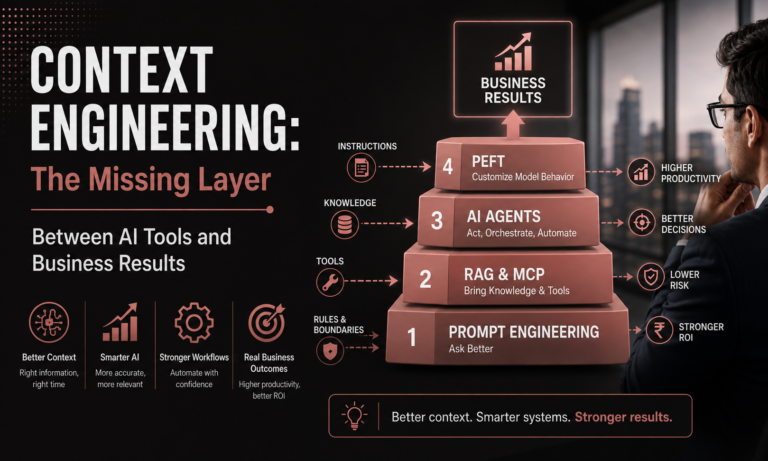
The LEADxAI Context Engineering model places Prompt Engineering before RAG + MCP for precisely this reason.
3. The workflow requires action rather than knowledge
Suppose the requirement is:
“Read this customer request, check the CRM, issue an approved refund and update the ticket.”
That is not simply a retrieval problem.
It involves:
- retrieval;
- reasoning;
- tool use;
- permissions;
- workflow execution;
- potentially multiple steps.
That may call for an AI agent with RAG, rather than RAG alone.
4. The underlying data is unreliable
RAG does not turn bad information into good information.
If the knowledge base contains:
- outdated documents;
- contradictory policies;
- duplicate files;
- incorrect data;
- missing metadata;
the retrieval system may retrieve the wrong information.
The AI can then produce a perfectly fluent answer based on imperfect context. This is why data readiness comes before RAG architecture.
RAG vs Prompt Engineering vs AI Agents vs Fine-Tuning
This is one of the most important sections for enterprise decision-makers.
| Business requirement | Usually consider |
|---|---|
| Give AI better instructions | Prompt Engineering |
| Give AI current/private enterprise knowledge | RAG |
| Let AI interact with external tools | MCP / tool integration |
| Let AI perform multi-step work | AI Agents |
| Change specialised model behaviour | PEFT / Fine-tuning |
The LEADxAI Context Engineering ladder uses this exact progression:
Prompt Engineering → RAG + MCP → AI Agents → PEFT
The purpose is not to push organisations toward the most technically advanced solution. It is to help leaders identify the minimum capability required for the business problem.
RAG vs fine-tuning: Which should an enterprise choose?
This is a common source of confusion.
Imagine your company has 50,000 internal documents.
You want an AI assistant to answer questions about those documents.
Your first thought might be:
“Let’s fine-tune the model on all our data.”
That may be the wrong approach.
A useful distinction is:
RAG is primarily about giving the model access to relevant knowledge.
Fine-tuning is primarily about changing or specialising model behaviour.
Consider this:
| Requirement | RAG | Fine-tuning |
|---|---|---|
| Current company knowledge | ✅ | Usually not the primary solution |
| Frequently changing documents | ✅ | Poor fit |
| Source-grounded answers | ✅ | Not inherently |
| Company-specific facts | ✅ | Not the main purpose |
| Consistent output style | Possible | ✅ |
| Specialised behaviour | Limited | ✅ |
| Update knowledge frequently | Easier | More involved |
| Need to retrain/update model | Usually no | Often part of workflow |
| Best first step for enterprise knowledge | Often | Usually not |
The LEADxAI curriculum makes the distinction explicitly: “RAG is for facts; PEFT is for behavior.”
That is an excellent mental shortcut for business leaders.
RAG vs AI Agents
Another important distinction:
RAG retrieves.
An agent can decide, retrieve, use tools and act.
Consider an internal policy assistant.
Basic RAG
Employee asks:
“What is our parental leave policy?”
System:
Retrieve policy → Generate answer
That is a good RAG use case.
Now consider:
“Check whether this employee is eligible, calculate the applicable leave, create the HR request and notify the manager.”
Now the system needs to:
- retrieve policy;
- retrieve employee information;
- reason over eligibility;
- possibly call HR systems;
- create a request;
- notify another system/user;
- handle exceptions.
That’s moving toward agentic workflow architecture.
Sudhanshu’s existing Agentic RAG material describes the difference well: in basic RAG, retrieval is relatively direct; in agentic RAG, an agent can decide what to search, refine queries, perform multiple retrieval rounds and coordinate tools.
What are the best enterprise RAG use cases?
The strongest RAG use cases generally involve knowledge-intensive work where the answer depends on organisational information.
1. Enterprise knowledge assistants
Employees can ask questions about:
- policies;
- SOPs;
- processes;
- internal documentation;
- organisational knowledge.
Instead of searching through ten systems manually, they can ask one question.
2. HR policy assistants
An HR RAG system can help employees find information about:
- leave;
- benefits;
- travel policies;
- reimbursement;
- onboarding;
- workplace policies.
The important caveat is that the system should use approved and current policy sources.
3. Customer support
A support assistant can retrieve information from:
- product documentation;
- troubleshooting guides;
- FAQs;
- service manuals;
- approved support content.
This can help support teams respond more consistently.
4. Legal and compliance knowledge
Potential use cases include searching:
- policies;
- regulations;
- contracts;
- compliance documentation;
- internal controls.
For high-risk decisions, however, retrieval should support—not automatically replace—appropriate professional review.
5. Sales enablement
A sales knowledge assistant can retrieve:
- product information;
- case studies;
- proposals;
- approved messaging;
- customer information;
- competitive intelligence.
This can reduce the time sales teams spend searching for internal material.
6. Technical support
Engineering teams often have information scattered across:
- architecture documentation;
- incident reports;
- tickets;
- manuals;
- code documentation;
- knowledge bases.
RAG can provide a common retrieval layer across that knowledge.
What does an enterprise RAG architecture look like?
At a conceptual level:
The important point is that the LLM is only one component.
Enterprise RAG is an information system.
Its quality depends on the entire pipeline.
The five layers of enterprise RAG
Layer 1: Knowledge sources
Where does the information come from?
Examples:
- SharePoint;
- Confluence;
- Google Drive;
- databases;
- document repositories;
- internal applications.
Layer 2: Knowledge preparation
Documents may need:
- cleaning;
- parsing;
- chunking;
- metadata;
- version management;
- deduplication;
- access-control tagging.
Garbage in, garbage retrieved.
Layer 3: Retrieval
The system must find the right information.
This may involve:
- semantic search;
- keyword search;
- hybrid retrieval;
- metadata filtering;
- re-ranking.
The challenge is not simply finding something relevant.
It is finding the most useful context for the specific question.
Layer 4: Generation
The LLM receives:
Question + retrieved context + instructions
and generates the answer.
A strong system should also be designed to recognise when the retrieved information is insufficient.
Layer 5: Evaluation
This is the layer many RAG pilots underestimate.
You need to know:
- Was the right document retrieved?
- Was the answer supported by the retrieved context?
- Did the system miss relevant information?
- Did it hallucinate?
- Did it cite the right source?
- How often does it fail?
Sudhanshu’s RAG framework specifically identifies evaluation and monitoring as part of a strong RAG system rather than treating retrieval as a one-time implementation.
The biggest enterprise RAG mistake: “Put all our documents into a vector database”
This sounds logical.
It isn’t necessarily good architecture.
Imagine an organisation has:
500,000 documents.
That doesn’t mean all 500,000 documents should be treated equally.
Some could be:
- obsolete;
- duplicated;
- confidential;
- contradictory;
- poorly written;
- irrelevant;
- owned by different departments;
- subject to different access controls.
A good RAG implementation starts with:
What knowledge should the AI be allowed to use?
Not:
How much data can we put into the system?
Enterprise RAG needs access control
This is especially important.
Suppose:
- Employee A can access documents 1–100.
- Employee B can access documents 1–500.
- HR can access employee records.
- Legal can access contracts.
A RAG system must not accidentally expose restricted information simply because the retrieval layer can find it.
This means enterprise RAG architecture needs to consider:
- authentication;
- authorisation;
- role-based access control;
- document-level permissions;
- metadata;
- data classification;
- auditability.
This is why enterprise RAG is fundamentally different from building a personal “chat with PDF” application.
Does RAG eliminate hallucinations?
No.
This is one of the most important misconceptions.
RAG can reduce hallucination risk by grounding generation in retrieved information.
But it does not guarantee perfect answers.
A system can still fail because:
- the wrong document was retrieved;
- the right document was missing;
- retrieval returned incomplete context;
- the model misinterpreted the context;
- documents contradict each other;
- the question is ambiguous;
- the model generated unsupported information.
Therefore:
RAG should be treated as a grounding strategy, not a hallucination elimination strategy.
Evaluation and monitoring remain necessary.
How much does enterprise RAG cost?
There is no responsible single answer.
The cost depends on:
- number of documents;
- document complexity;
- ingestion frequency;
- retrieval architecture;
- embedding model;
- vector/search infrastructure;
- LLM;
- traffic;
- context size;
- security requirements;
- integration requirements;
- monitoring;
- engineering;
- maintenance.
A better enterprise question is:
What is the cost per useful business outcome?
For example:
Cost per successfully resolved support case
may be more useful than:
Monthly RAG infrastructure cost.
This aligns with the LEADxAI AI ROI Engine, which starts with metrics, prioritises the KPI that matters, automates against it, and then tracks the deployed result.
How do you calculate RAG ROI?
Start with the existing process.
For example:
| Metric | Before RAG | After RAG target |
|---|---|---|
| Average search time | 15 min | 3 min |
| Questions resolved without escalation | 55% | 80% |
| Average handling time | 12 min | 6 min |
| First-response SLA | 75% | 95% |
| Cost per interaction | ₹X | ₹Y |
The actual numbers should come from the organisation’s baseline.
Do not invent ROI.
Measure it.
A RAG project becomes much easier to defend to leadership when the business case can be stated as:
“We are reducing X from A to B.”
rather than:
“We built an AI knowledge assistant.”
When should an enterprise build RAG?
Use this decision checklist.
RAG is probably worth evaluating if:
- The AI needs private enterprise knowledge.
- The knowledge changes regularly.
- Users repeatedly ask questions about that knowledge.
- The source documents can be curated.
- Search/retrieval is a meaningful part of the workflow.
- Answers need grounding.
- There is a measurable business problem.
- Security and access controls can be implemented.
- There is a business owner.
- Success can be measured.
RAG may not be the right first move if:
- The task only needs general knowledge.
- Better prompting solves the problem.
- The knowledge base is unreliable.
- There is no measurable business problem.
- The workflow actually requires actions and tool use.
- The business cannot maintain the knowledge sources.
- The cost of retrieval exceeds the value created.
RAG belongs inside a larger Context Engineering strategy
RAG should not be treated as an isolated technology.
The LEADxAI Context Engineering model treats enterprise AI as four related capability levels:
| Level | Capability | Business question |
|---|---|---|
| 1 | Prompt Engineering | How should we communicate with AI? |
| 2 | RAG + MCP | How does AI access knowledge and tools? |
| 3 | AI Agents | Can AI perform multi-step work? |
| 4 | PEFT | Does the model itself need customisation? |
This creates an important principle:
Don’t jump to RAG because you have documents. Use RAG when retrieval solves a real business problem.
How should an enterprise move from RAG POC to production?
This is where many projects struggle.
A successful demo might take:
documents → embeddings → search → answer
Production requires considerably more.
Before production, evaluate:
Data
- Is the information current?
- Is ownership clear?
- Are versions controlled?
Retrieval
- Does the right information appear?
- What happens when retrieval fails?
Security
- Can users access only authorised information?
Evaluation
- How is answer quality measured?
Cost
- What does each useful interaction cost?
Operations
- Who monitors the system?
Governance
- What happens when the answer is wrong?
Adoption
- Will employees actually use it?
The LEADxAI BUILD framework specifically includes POC-to-production, token/unit economics, security, PII and RBAC as enterprise architecture considerations.
The 10 questions to ask your RAG vendor
Before approving an enterprise RAG project, ask:
- What exact business problem is RAG solving?
- Which knowledge sources will be indexed?
- Who owns those sources?
- How will outdated documents be handled?
- How will access permissions be enforced?
- How will retrieval quality be evaluated?
- How will hallucinations be detected?
- What is the cost per useful interaction?
- What happens when the system cannot find an answer?
- Who owns the business outcome?
If a vendor can answer all ten clearly, you are having an enterprise architecture conversation.
If the conversation is mostly about:
“Our vector database supports 10 billion embeddings.”
you may be having the wrong conversation.
RAG implementation: a practical 90-day approach
For an enterprise starting from scratch, avoid trying to index the entire organisation.
Days 1–20: Diagnose
Identify:
- one business problem;
- one knowledge domain;
- source systems;
- users;
- baseline KPI;
- security requirements.
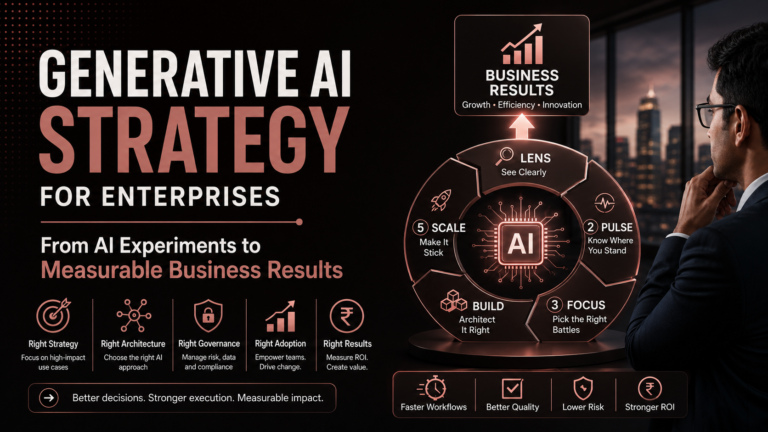
This follows the broader LENS + PULSE thinking in LEADxAI: understand the environment and assess readiness before building.
Days 21–45: Design
Define:
- knowledge sources;
- retrieval approach;
- access model;
- evaluation method;
- LLM;
- expected cost;
- user workflow.
Days 46–70: Pilot
Use a controlled dataset.
Measure:
- retrieval quality;
- answer quality;
- unsupported answers;
- user satisfaction;
- latency;
- cost.
Days 71–90: Decide
Choose one:
Scale: if value and reliability are proven.
Improve: if the concept works but retrieval/data quality needs work.
Pivot: if the workflow needs an agent or different architecture.
Stop: if the economics or business value don’t justify continued investment.
Stopping an AI initiative is not necessarily failure.
Sometimes it is evidence of good AI governance.
What does good enterprise RAG look like?
A mature RAG system is not simply:
LLM + vector database
It is closer to:
Trusted knowledge + retrieval + context + model + evaluation + access control + governance + measurable business outcome
That is a fundamentally different mindset.
The technical architecture matters.
But the business architecture matters just as much.
RAG for Enterprises: The 7-point test
If you remember only one framework from this article, use this:
1. Knowledge
Does AI need information your model does not reliably know?
2. Freshness
Does that information change?
3. Retrieval
Can the relevant information be found reliably?
4. Trust
Can the answer be grounded in approved sources?
5. Security
Can users access only what they are authorised to see?
6. Economics
Will the workflow create more value than it costs?
7. Outcome
What business KPI will improve?
If the answer to most of these is yes, RAG is worth serious consideration.
If several are no, don’t build RAG simply because every enterprise AI presentation has a vector database diagram.